
Abstract Erotic: Louise Bourgeois, Eva Hesse, Alice Adams
The Courtauld Gallery, London, UK
June 20 – September 14, 2025
The Courtauld’s latest exhibition, Abstract Erotic, may only span two rooms, but it brings together an extraordinary trio of artists whose work still ripples with energy. Featuring Louise Bourgeois, Eva Hesse, and Alice Adams, the show revisits a moment of radical material exploration and sensuous abstraction that reshaped the language of sculpture in the 1960s.

Louise Bourgeois (1911–2010) was a French-American artist whose emotionally charged sculptures, installations, and drawings explored themes like trauma, memory, and the body — often rooted in her complex and traumatic childhood. She worked with a wide range of materials, from bronze to fabric, and gained international acclaim later in life, particularly for her iconic spider sculptures symbolising motherhood and protection.
I was already familiar with her work, having seen several pieces at Tate Modern — including one of her giant spiders now in the Turbine Hall — and a textile-focused retrospective at the Hayward Gallery in 2022, which you can find here. It’s fascinating how she managed to channel such a complex past into work that is both moving and deeply visceral, creating a unique and deeply personal artistic language.

The art blueberry next to Louise Bourgeois’ artworks
Eva Hesse (1936–1970) was a German-American artist and a key figure in the postminimalist movement of the 1960s. Her work broke away from the rigid forms of minimalism through the use of unconventional materials like latex, fibreglass, and rope, exploring fragility, repetition, and organic form with radical intimacy. Though her career was tragically short — she died at just 34 — she left a lasting legacy on contemporary sculpture.
I had seen some of her pieces in the past, as well as a documentary about her work a few years ago. As one of the most recognisable artists of postminimalism, Eva Hesse created uniquely sensuous and evocative works, rich in meaning despite their apparent simplicity.


Eva Hesse’s artworks selection, No title
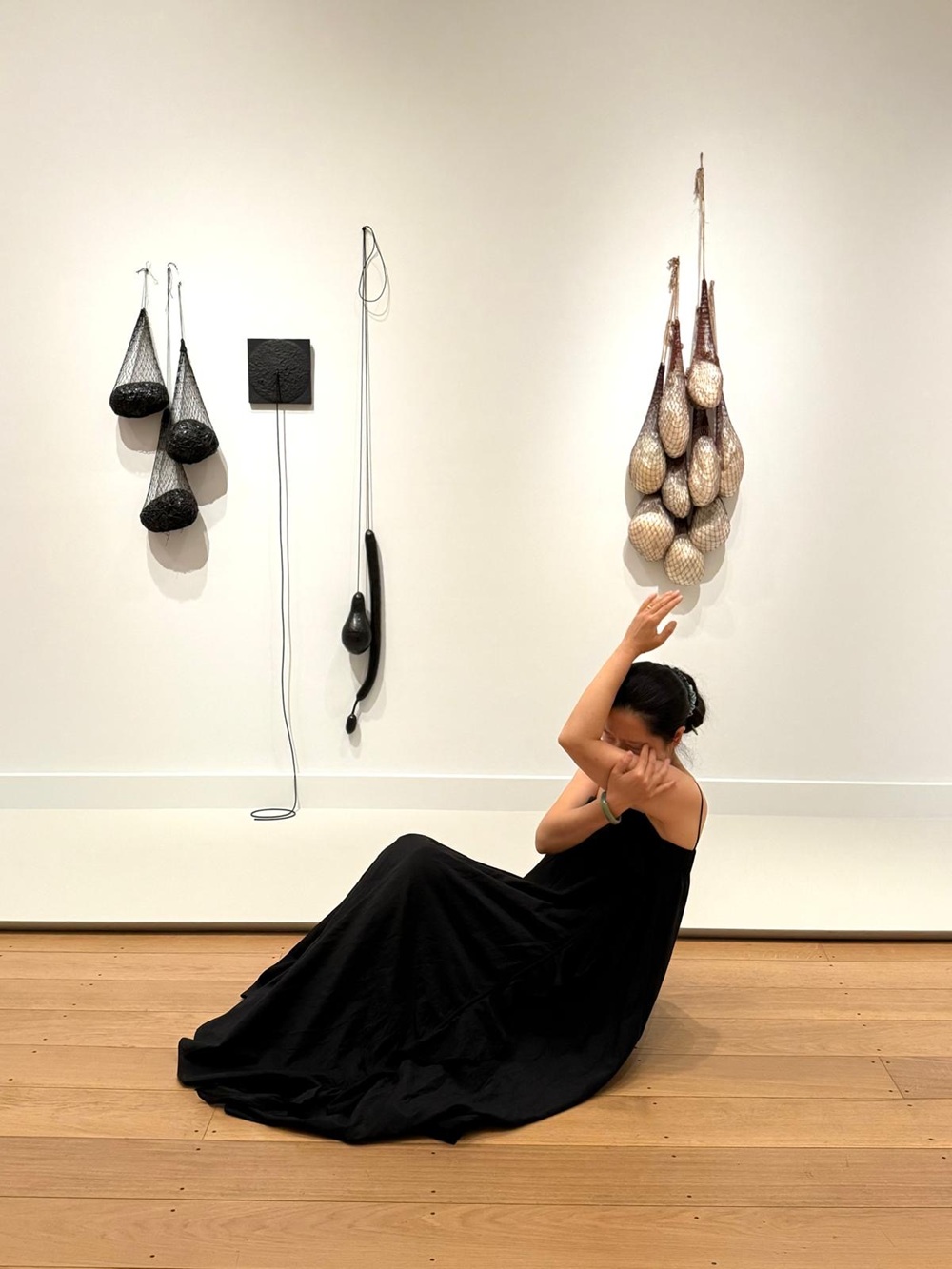
Alice Adams (nacida en 1930) is an American artist whose early work bridges sculpture, textile art, and architecture. Trained as a weaver, she brought fibre-based techniques into the sculptural realm, creating intricate forms from rope, wire, and industrial materials. In the 1970s, she began working on large-scale public commissions across the U.S., blending art with the built environment.
This exhibition marks the first time her work is shown in a UK museum context. It’s mesmerising to see how the woven language of her early practice still shapes her sculptural imagination, guiding the viewer through tactile, unfolding journeys.


The Art Blueberry next to Alice Adams’ artworks
These artists, working primarily with latex, rubber, fibreglass, foam, and plaster, created forms that are evocative, ambiguous, and at times unsettling. Fleshy mounds, woven tangles, and drooping, sausage-like suspensions occupy the space — not as representations of the body, but as something more elusive. The exhibition doesn’t simply point to bodily forms; rather, it explores the slippage between surface and interior, between the whole and the fragmented, the familiar and the strange. Sculptural objects seem to hover between image and form, eroticism and vulnerability.
To understand this exhibition fully, it’s worth revisiting Lucy Lippard’s groundbreaking 1966 exhibition Eccentric Abstraction, staged at the Fischbach Gallery in New York. It was her first independent curatorial project, in which she sought to blur the boundaries between the rigid geometry of minimalism and something more sensuous, personal, and embodied. Lippard’s accompanying article, published in Art International, championed artists who rejected cool detachment in favour of tactile surfaces and evocative materials. Bourgeois, Hesse, and Adams were the only women in the show, and their contributions stood out for their striking physicality and emotional depth. As Lippard later reflected, “I can see now that I was looking for feminist art.”
Abstract Erotic thoughtfully reflects on this history. Alongside the sculptures, The Courtauld also presents a room of Bourgeois’s drawings — restless, obsessive, and charged. These works, filled with waves, breast forms, repetitive marks, and swirling gestures, feel like raw emotional topographies rather than formal studies. As Lippard observed, many of the artists in Eccentric Abstraction began as painters, and this painterly sensibility flows through their sculptural language.


Louise Bourgeois’ drawings selection
The exhibition arrives at a time when interest in underrepresented female artists continues to grow. For decades, many of these voices remained overshadowed by their male peers. By showcasing these three women — who in the 1960s forged a deeply personal and disruptive sculptural vocabulary — The Courtauld offers a timely and necessary spotlight.
Though from different generations, Bourgeois, Hesse, and Adams shared a geographic and creative space: the experimental, downtown art scene of 1960s Manhattan. Bourgeois was already established and would go on to inspire a new wave of younger women artists. Hesse, who died tragically young in 1970, left behind a groundbreaking yet fragile body of work. Adams, now in her nineties, continues to live and work in New York; this is the first time her work is exhibited in the UK and her first-ever museum show.
You can sense the passage of time in some of the materials — aged latex, dulled surfaces — but the intensity of these works has not faded. These sculptures still speak: of the body, of memory, of resistance to containment. In Abstract Erotic, The Courtauld gives us a potent reminder of how radical softness can be — and still is.
Leave a Reply