
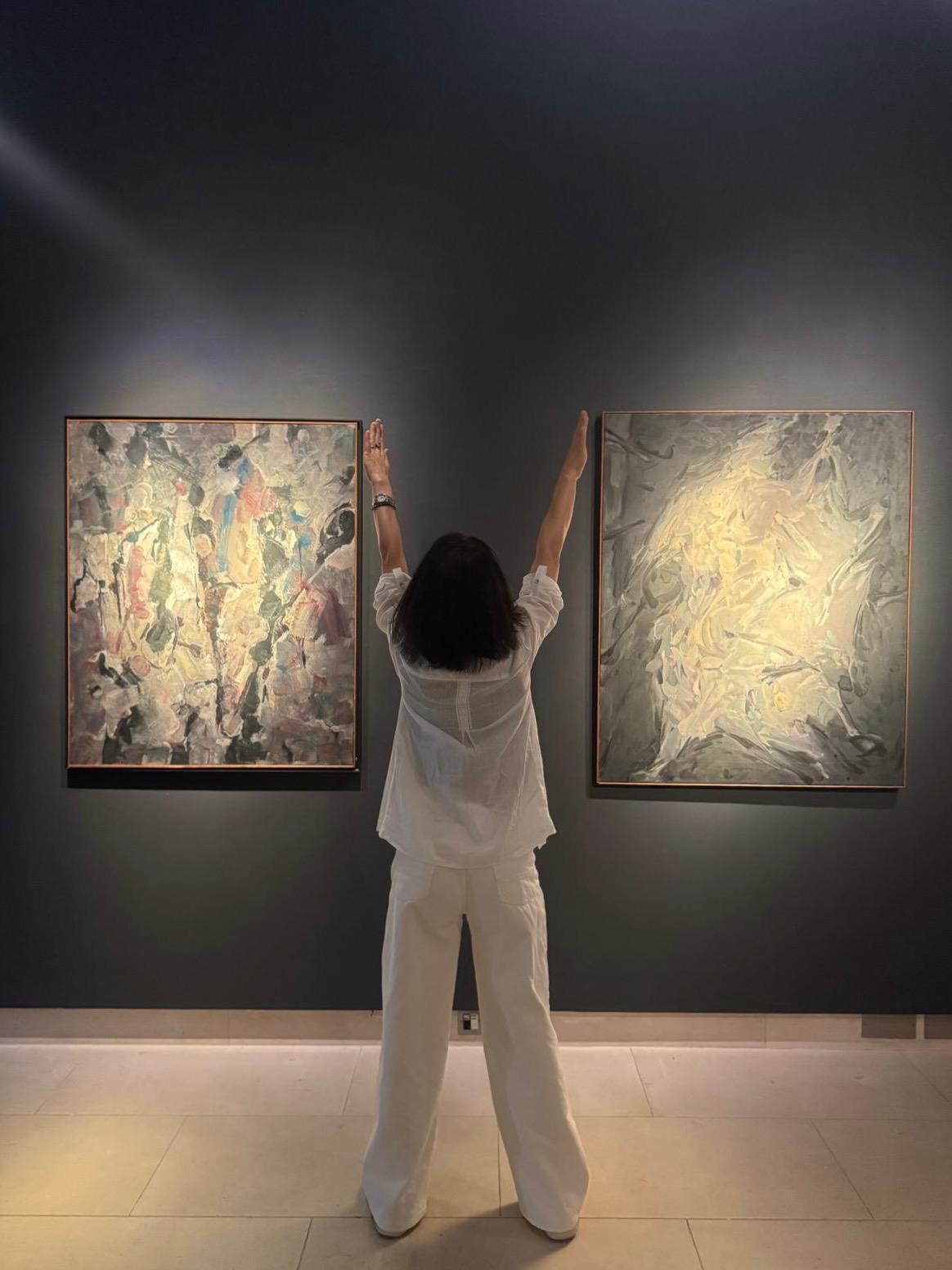
Marwan: A Soul in Exile
Christie’s Headquarters, London, UK
July 16 – August 22, 2025
A couple of weeks ago, I visited Marwan: A Soul in Exile at Christie’s London — a must-see if you’re in the city this summer. The exhibition, running until August 22, celebrates Marwan Kassab-Bachi (1934–2016), one of the most significant Arab artists, internationally recognised in modern and contemporary art.
I first discovered the show through a striking poster in the London Underground. The reproduction of one of Marwan’s works caught my eye, and I visited a week later. The art exhibition is part of the third Arab art showcase at Christie’s and focuses on the Syrian-born painter, who moved to Germany in the late 1950s. Influenced by German Expressionism and the Neue Wilde while remaining deeply connected to his Syrian heritage, Marwan explored identity, exile, and the human condition through a unique fusion of styles.
Marwan is renowned for reimagining portraiture as a space for psychological exploration. His “facial landscapes” — layered in four or five hues to suggest skin and emotion — transform the head into undulating topographies, metaphysical gateways to the soul. Rooted in both the Syrian national movement and Sufi poetic tradition, his work engages with themes of land, identity, and spirituality.
Spread across two floors, the exhibition begins on the ground level with early works (1957–1963): dark, dreamlike terrains of distorted figures reflecting Marwan’s isolation as a new arrival in post-war Berlin. Initially drawn to Abstract Expressionism and French Tachisme, he gradually shifted toward figuration, often using his own body as subject. These works convey exile’s vulnerability and earned him a place at Galerie Springer in 1967.


From 1963–1973, Marwan focused on drawings and watercolours: quiet, contemplative studies of fragmented human forms, sometimes bordering on the absurd. The repetition in these pieces evokes Sufi ritual, where rhythm leads to inner transformation. In the wake of the 1967 Six-Day War, he painted figures veiled in keffiyehs, distilling conflict, exile, and collective sorrow into powerful symbols.


The early 1970s marked a turning point. A scholarship to the Cité Internationale des Arts in Paris in 1973 introduced warmer, richer tones — including baroque crimson — and led to his most iconic series, the Facial Landscapes. Here, nostalgia and geography merged, transforming faces into inner terrains. I especially like how these works echo the contours of his native Damascene landscape, particularly Mount Qasioun — not directly depicted, but suggested in the swell of a brow, the slope of a cheek, or the furrow of a forehead.

His 1976 retrospective at Orangerie Charlottenburg solidified his place in Berlin’s art scene. However, I found the works on the lower level more poignant. They felt more closely tied to Syria, rich with political references, and they resonated with me more deeply despite not being as well known.

Upstairs, later works from the late 1970s onward reveal a turn to still life and the recurring motif of the marionette — a metaphor for theatricality, control, and solitude. In the 1980s, following his sister’s death, his elongated vertical faces confronted viewers with solemn directness, painted in dense layers without preparatory sketches. This floor also highlights Marwan’s influence as a mentor to a generation of Arab artists from Beirut, Gaza, Damascus, and Baghdad.


Seeing these works together, drawn from multiple collections, is rare. His 1960s paintings gripped me with their rawness, his works on paper revealed his draughtsmanship, and his later layered portraits showed how he refined his voice to influence an entire generation.
Entrance: Free.
Leave a Reply