
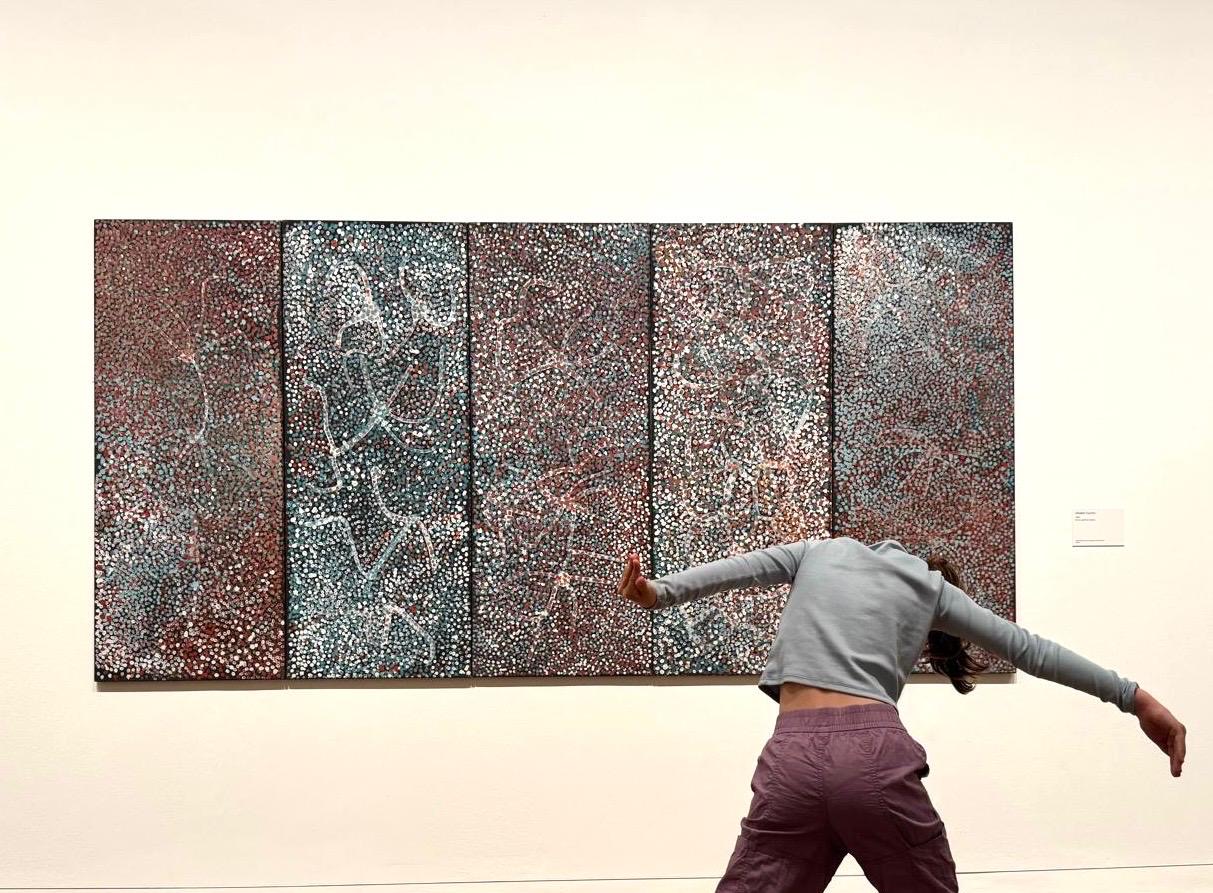
Emily Kam Kngwarray
Tate Modern, London, UK
10 July 2025 – 11 January 2026
Today I want to draw your attention to an artist who has the power to open the mind to radically different ways of seeing and inhabiting the world. Emily Kam Kngwarray, one of the most extraordinary figures in international contemporary art, currently has a major exhibition at Tate Modern, well worth visiting if you are in London before 11 January.
Emily Kam Kngwarray (c.1914–1996) was an Aboriginal Australian artist from Alhalker, in the Sandover region of the Northern Territory. A senior Anmatyerr woman, she translated her ceremonial and spiritual engagement with her ancestral territory into vividly patterned batik textiles and monumental acrylic paintings. Remarkably, she took up painting on canvas in her seventies and devoted the final years of her life to an astonishingly prolific artistic output.


Kngwarray grew up working on cattle stations. Land to the east of Alhalker was taken over by white settlers and renamed Utopia, where many Aboriginal people, including Kngwarray, laboured on pastoral properties. Despite these disruptions, cultural knowledge and ceremonial practices endured. As an elder and ancestral custodian, Kngwarray had painted for ceremonial purposes for decades before her work entered the contemporary art sphere.
She began working with batik in 1977 and moved to painting on canvas in 1988, also producing works on paper and, in the early 1990s, a small number of prints including etchings and linocuts. Over the course of her life, she created an expansive and influential body of work and was at the forefront of a profound Aboriginal artistic revolution in Australia.
Kngwarray’s art embodies her intimate knowledge of the land she lived on throughout her life. Her layered compositions map desert ecosystems through motifs representing plants, animals and geological features. Her practice was deeply shaped by women’s ceremonial traditions of awely, which encompass song, dance and the painting of bodies with ground ochres. She often sat on the ground to paint, mirroring everyday and ceremonial acts—preparing food, digging yams, telling stories through drawings in the sand, or painting up for awely ceremonies.
The exhibition opens with one of her earliest batiks on cotton from 1977, shown alongside Emu Woman (1988), her first painting on canvas and the work that brought her national recognition. Kngwarray frequently depicted the emu (ankerr), a significant ancestral being, as well as the pencil yam (anwerlarr) and its edible underground seedpods (kam), from which she takes her name.
For Aboriginal and Torres Strait Islander Peoples, ancestral beings—commonly known as Dreamings—manifest themselves in country and its many life forms. Ntang Dreaming (1989) depicts the edible seeds of woollybutt grass, while Ankerr (Emu) (1989) maps a path of emu footprints travelling between water sources.


In her final years, Kngwarray underwent a striking stylistic shift, producing works composed of bold, parallel monochrome lines in her familiar palette of reds and yellows, often on white paper or canvas. Tate Modern presents Untitled (Awely) (1994), a six-panel work originally shown as the centrepiece of the Australian Pavilion at the 1997 Venice Biennale. The tactile application of paint evokes the intimacy and gesture of ceremonial body painting.


Later works move away from lines and dots altogether, developing fluid, gestural brushstrokes that pulse with energy. The exhibition closes with Yam Awely (1995), whose twisting whites, yellows and reds intertwine with linear markings of grasses, roots and tracks, expressing the timeless bond between Kngwarray and her ancestral territory.

Kngwarray died in 1996 and represented Australia at the Venice Biennale the following year. Her work has had a profound impact both in Australia and internationally, inspiring generations of Aboriginal artists.
The exhibition presents the artist through the lens of her own world, as part of her close community and in connection with the land where she grew up and knew so well. It showcases an artist in deep connection with her ancestral territory and brings together over 70 works, many of which have never been shown outside Australia before. The experience of being immersed in such vibrant colours and natural motifs is truly fascinating.
Entrance: £22 / Free for Members
Leave a Reply