
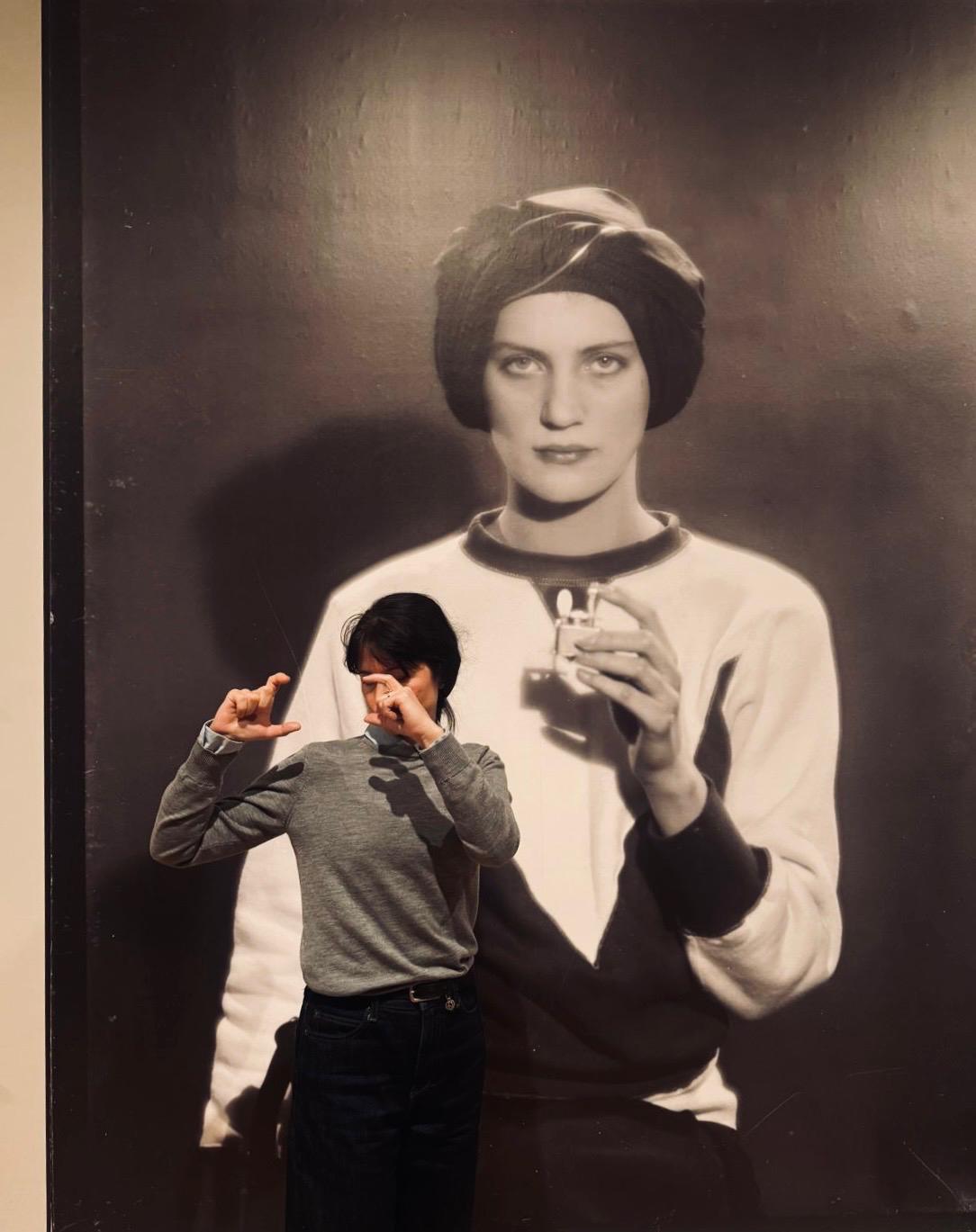
Lee Miller
Tate Britain, London, UK
2 October 2025 – 15 February 2026
I was fascinated by this exhibition of Lee Miller at Tate Britain. If you haven’t seen it yet, I strongly recommend going. There are only a few weeks left before it closes, and the journey through her life and work is genuinely inspiring. What stayed with me most was her poetic vision and, above all, her fearless spirit.
Lee Miller (1907–1977), later Lady Penrose, was an American photographer and photojournalist, and one of the most compelling artistic voices of the twentieth century. She began her career as one of the most sought-after fashion models of the 1920s, appearing on the covers of British and American Vogue. Yet she was far more interested in making images than being one, famously declaring she would “rather take a picture than be one”.


Her move to Paris in 1929 marked a decisive turning point. Introducing herself unannounced to Man Ray, she entered the heart of the avant-garde and embarked on an intense period of creative and romantic collaboration. Together they experimented with techniques such as solarisation, sharing studios, subjects, and ideas in a fluid artistic dialogue that makes authorship difficult to disentangle. By 1930, Miller had outgrown the role of assistant and established her own studio, firmly asserting her independence as an artist.
The exhibition beautifully traces this period of extraordinary creative energy, from her surrealist experiments to her striking street photography in Paris, where light and shadow are used to disrupt familiar contexts and create new meanings. By her mid-twenties, Miller was already exhibiting internationally, and in 1932 she held her first solo exhibition in New York at the Julien Levy Gallery, where she was hailed as “the new light on the horizon of photography”.


Exhausted by the commercial demands of studio work, Miller left New York in 1934, marrying Egyptian businessman Aziz Eloui Bey and moving to Cairo. Freed from professional constraints, she returned to photography on her own terms, producing some of her most enigmatic work during her travels across Egypt, the Middle East, and Eastern Europe. These images reveal her fascination with ambiguity, strong silhouettes, and double meanings.


A later section of the exhibition focuses on her portraiture, including images of leading artists and intellectuals, as well as her work for Vogue during the Second World War. Although she became the magazine’s leading photographer, censorship and editorial constraints frustrated her deeply.
As she wrote to her parents, “It seems pretty silly to go on working on a frivolous paper like Vogue… it’s hell on my morale.” Lee Miller
In 1944, Miller finally became an accredited war correspondent for the US Army, covering the front lines of Europe alongside photographer David E. Scherman. She was one of only a handful of women to document combat during the war, producing some of the most uncompromising images of the period.


After the war, Miller gradually withdrew from photography. Settling in East Sussex with her husband Roland Penrose and their son Antony, she turned her creative energy elsewhere, becoming a celebrated cook. Much of her photographic work remained unseen until Antony Penrose later uncovered and championed her archive.


I found this exhibition compelling not only because of the glamorous early images, from a decade defined by women’s hunger for freedom, but because of Miller’s relentless drive to shape her own artistic path. She experimented boldly with a medium still in its infancy, broke conventions, and pursued truth with remarkable courage during one of the most turbulent periods of modern history. Lee Miller is a cultural icon of the twentieth century, and this exhibition finally gives her the recognition she deserves.


Leave a Reply