
Anni Albers
Tate Modern, London, UK
11 October 2018 – 27 January 2019
We were at Tate Modern last week visiting the exhibition of Anni Albers (1899–1994), an artist who fused the tradition of hand-weaving with the language of modern art — and what I believe is one of the best art shows in London at the moment. Don’t miss it, as it’s closing very soon.
Featuring over 350 objects, from small-scale studies to large wall hangings, jewellery, and textiles designed for mass production, the show explores the meeting point between art and craft, hand-weaving and industry, ancient techniques and modern aesthetics. Opening ahead of the Bauhaus centenary in 2019, the exhibition recognises Albers’s influential contribution to modern art and design.
The hand-woven pieces on display are strikingly diverse in shape, colour, and scale. It feels as though Albers spent her entire life experimenting — pushing design, technique, and material forward — while always maintaining a distinctive personal style.
Each artwork appears like a small treasure created with intense care and deep reflection. She transformed everyday objects into precious jewellery and explored a wide range of textures and materials, producing outcomes that feel both surprising and deeply considered.
Each artwork appears like a small treasure created with intense care and deep reflection. She transformed everyday objects into precious jewellery and explored a wide range of textures and materials, producing outcomes that feel both surprising and deeply considered.
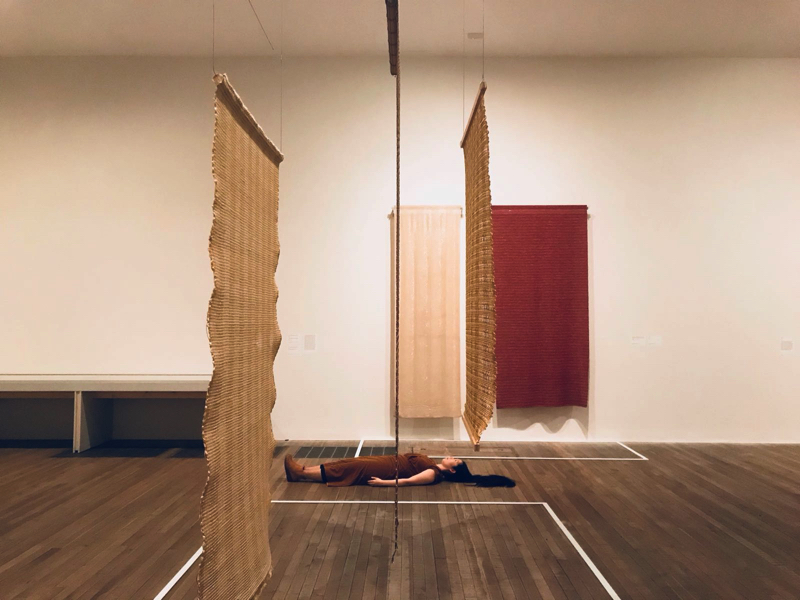
I was drawn to the large wall hangings with their refined abstract patterns, as well as the intimate, small-scale pieces that reveal extraordinary attention to detail. There is also a spacious central room displaying wall hangings reminiscent of Japanese blinds, which we chose as the backdrop for our photos — perfect for contemplating the contemporary art environment and the body’s interaction within it.
Born in Berlin at the turn of the century, Annelise Else Frieda Fleischmann enrolled at the Bauhaus in 1922, where she met her husband Josef Albers and other key modernist figures such as Paul Klee. The Bauhaus — active from 1919 to 1933 — profoundly shaped modern art, architecture, design, and typography. Although the school aspired to gender equality, women were still discouraged from studying certain disciplines, including painting. Albers turned to weaving almost by default, yet it became her true medium, one she embraced throughout her career.
With the rise of Nazism and the closure of the Bauhaus, Albers moved to the United States in 1933, teaching for more than 15 years at the experimental Black Mountain College. During this time she travelled frequently to Mexico, Chile, and Peru, collecting ancient Pre-Columbian textiles. Throughout her work and writing, she expanded the geography of modern art, drawing from African, Asian, and Indigenous American sources.
Visiting the exhibition was an invigorating experience, and I believe it will be equally inspiring for anyone who loves modern art, craft, and design as much as I do.


Leave a Reply