
Theatre Picasso
Tate Modern, London, UK
17 September 2025 – 12 April 2026
I walked into Tate Modern’s Theatre Picasso undecided. Was this a genuine interrogation of an icon, or just another attempt to squeeze life out of a permanent collection we’ve all seen before? If you are looking for a standard retrospective, you will be disappointed. But if you want to understand the mechanics of the 20th century’s most successful artistic brand, it demands attention.
Rather than reinforcing the trope of the “isolated genius,” curators Wu Tsang and Enrique Fuenteblanca have dismantled it. The gallery has been transformed into a dim, scenographic labyrinth where the white cube is replaced by a theatrical stage. To see the art, you must first navigate the artifice. You are not merely observing masterpieces; you are trespassing backstage in the 20th century.

Some of my favourite works are positioned right at the beginning of the exhibition, hanging from a metal fence. I am not particularly keen, in general, on displaying works too close to each other. I feel they lose part of the spotlight they deserve by lacking breathing space. However, I was glad to see them in full light. Girl in a Chemise (1905) from his Blue Period was displayed here, as well as a late etching on paper, Neo-Classical Painter in His Studio (1963). The latter shows his confidence with the line, alongside a whimsical and very recognisable lithograph composition from 1948.


The exhibition’s anchor is the centenary of The Three Dancers (1925). This painting marks a decisive turning point. It merges the structural fragmentation of Cubism with an intensified emotional force that anticipates Surrealism. Angular, contorted bodies, harsh colour contrasts and heavily worked surfaces generate an atmosphere of violence and erotic tension. Frequently associated with the suicide of Picasso’s friend Carlos Casagemas and the death of Ramón Pichot, the painting fuses personal grief with theatrical extremity. The ambiguous gestures oscillate between ecstasy and anguish, drawing on popular forms such as flamenco while distorting them into something raw and unsettling. High and low culture collapse into a charged choreography of longing and rupture.

Throughout the galleries, Picasso’s “Spanishness” is palpable. But, this wasn’t just heritage; it was a strategic asset. Despite living most of his life in France, he leaned into the ritualised violence of bullfighting and the energy of flamenco to perform “The Spaniard” for a Parisian audience hungry for primal intensity. He used this cultural difference to construct a persona as carefully staged as the sets he designed for the Ballets Russes.


Across the exhibition, you’ll see different portraits of various women who were also his lovers at the time. The impossibility of truly capturing the model became a dramatic impulse for him. It relentlessly drove his work throughout the years and reveals his transformation as an artist. His quest for possession of his models is palpable. The eyes of the model often return the viewer’s gaze, confronting us directly.


In the final room, you’ll encounter another work that connects with this painter-and-model dilemma: The Painter and His Model (1926). Here, we see how strongly he identified with the artist’s creative struggle to capture the sitter. He took Honoré de Balzac’s 1831 story, The Unknown Masterpiece, as inspiration, in which an old painter reveals a portrait of a woman as a confusing mass of colours after years of labour.

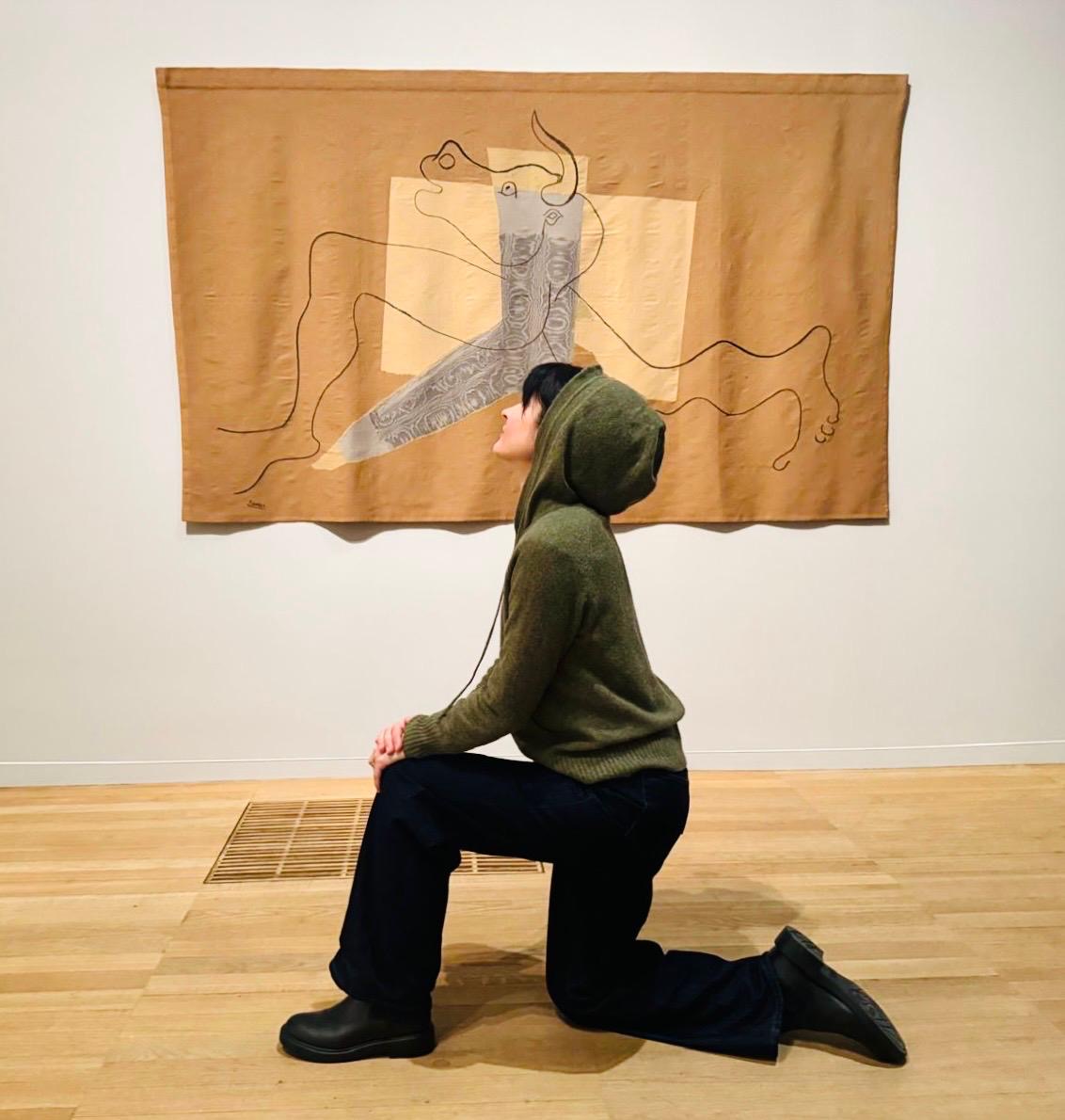
Another work in the final room that captured my attention was the Minotaur from 1928, a tapestry cartoon made of oil on canvas where he used the creature as a surrogate persona. By mirroring the contorted vitality of the Minotaur through my own theatrical posture, I am moving beyond passive observation to perform a visual interpretation that amplifies the raw, ritualistic energy of the work.

Finally, the other work that captured our attention in the show was The Acrobat (1930). He was always fascinated by circus performers and other non-conforming bodies. Inheriting the gesture: my daughter transforms observation into action, proving that true perceptual interpretation does not reside in the intellect, but in the capacity to inhabit the artist’s choreography.

The success of Theatre Picasso lies not in its scenography—which occasionally feels like a gimmick—but in its exposure of his greatest innovation: the collapse of the silo. We have spent a century obsessed with the “what” (the brushstrokes) while ignoring the “how” (the orchestration). He understood, perhaps better than any artist in history, that creativity is a product of cross-disciplinary symbiosis. By embedding himself in the circus, the ballet, and the opera, he wasn’t just finding new subjects; he was importing new energy systems into the static medium of painting. He used the kinetic logic of performance to shatter the stillness of the canvas.
Ultimately, this exhibition proves that his prolific output wasn’t just a result of talent, but of a sophisticated understanding of influence and leverage. He knew that the artist is the ultimate performance. Whether the Tate’s stage “works” as a gallery space is almost irrelevant. It serves its purpose by reminding us that for him, the world was always an audience, and art was merely the script.
Leave a Reply