
Picasso 1932: Love, Fame, Tragedy
Tate Modern, London, UK
8 March – 9 September 2018
I’m delighted to cover the first ever solo exhibition of Pablo Picasso at Tate Modern and what is certainly the blockbuster art show of the season here in London. I believe that Picasso was one of the most relevant figures in the arts in the 20th century, and a great artist who continued exploring new artistic avenues throughout his life.
I liked the curatorial work done for this EY exhibition at Tate Modern, just as I liked the one presented at the National Portrait Gallery at the end of 2016 based on Picasso Portraits. I found the latter excellent in showcasing the artist’s ability to redefine the portrait with each woman in his life.
In his personal life, he was 50 years old and his marriage to Olga Picasso (née Khokhlova) was under strain. The affair he was having with the significantly younger Marie-Thérèse Walter, a 22-year-old woman, offered him an escape and a source of inspiration for much of his work during this period. Walter is the central presence in this exhibition and inspired him to reach a new level of sensuality in his paintings.
From a career perspective, this was the year that cemented Picasso as a celebrity in the art world. A group of Paris dealers competed to launch the first retrospective of his work at a time when retrospectives of living artists were still unusual. Matisse’s retrospective at the Galeries Georges Petit in 1931 had been a rare exception, and Picasso wanted to have his own as well. He even declined offers from MoMA in New York and the Venice Biennale in order to mount a retrospective at the Galeries Georges Petit, which opened in June 1932. Picasso took full control of the show to avoid giving too much power to his dealers, but then he didn’t attend the opening, choosing instead to go to the cinema. That exhibition cemented his celebrity status and offered the first hint that there was a new woman in his life.
He escaped to Boisgeloup with Marie-Thérèse Walter in July and August, and his style became faster and more fluid. She was an excellent swimmer, and he used this fact to draw parallels between women and sea creatures, strongly influenced by surrealism.
Picasso once said that “The work one does is a way of keeping a diary.” The current exhibition at Tate Modern is like a diary that takes visitors on a month-by-month journey through 1932, a year often called his “year of wonders” for its significance to both his personal life and career.
This exhibition also presents some of the charcoal drawings he created in 1932. Some of them appear on canvas, as they were works in their own right rather than preparatory studies. For certain paintings, he preferred focusing on line and shape rather than colour. I was lucky to see the fantastic Picasso Black and White exhibition at the Guggenheim in New York in 2012, which explored his outstanding use of black and white throughout his career. It would be wonderful to see a similar art show in London sometime soon.
Towards the end of the exhibition, we see a series of drawings and paintings inspired by classical themes, both secular and religious, such as the Crucifixion, influenced by Matthias Grünewald’s Isenheim Altarpiece, and scenes of reclining nudes and flute players, mostly associated with surrealism—although Picasso was sceptical of group affiliation of any kind. The flute players in purple and green reminded me of Chagall’s figures, with their whimsical and magical touch.
The year that began with sensuous exuberance shifted into a darker mood after Marie-Thérèse became seriously ill after swimming in the river Marne. His paintings began to reflect scenes of rescue and struggle. Moreover, he grew increasingly anxious about the political situation in Europe at the time, with the rise of populist nationalism and totalitarian regimes, developments that would eventually lead to tragedy first in Spain and then across Europe.
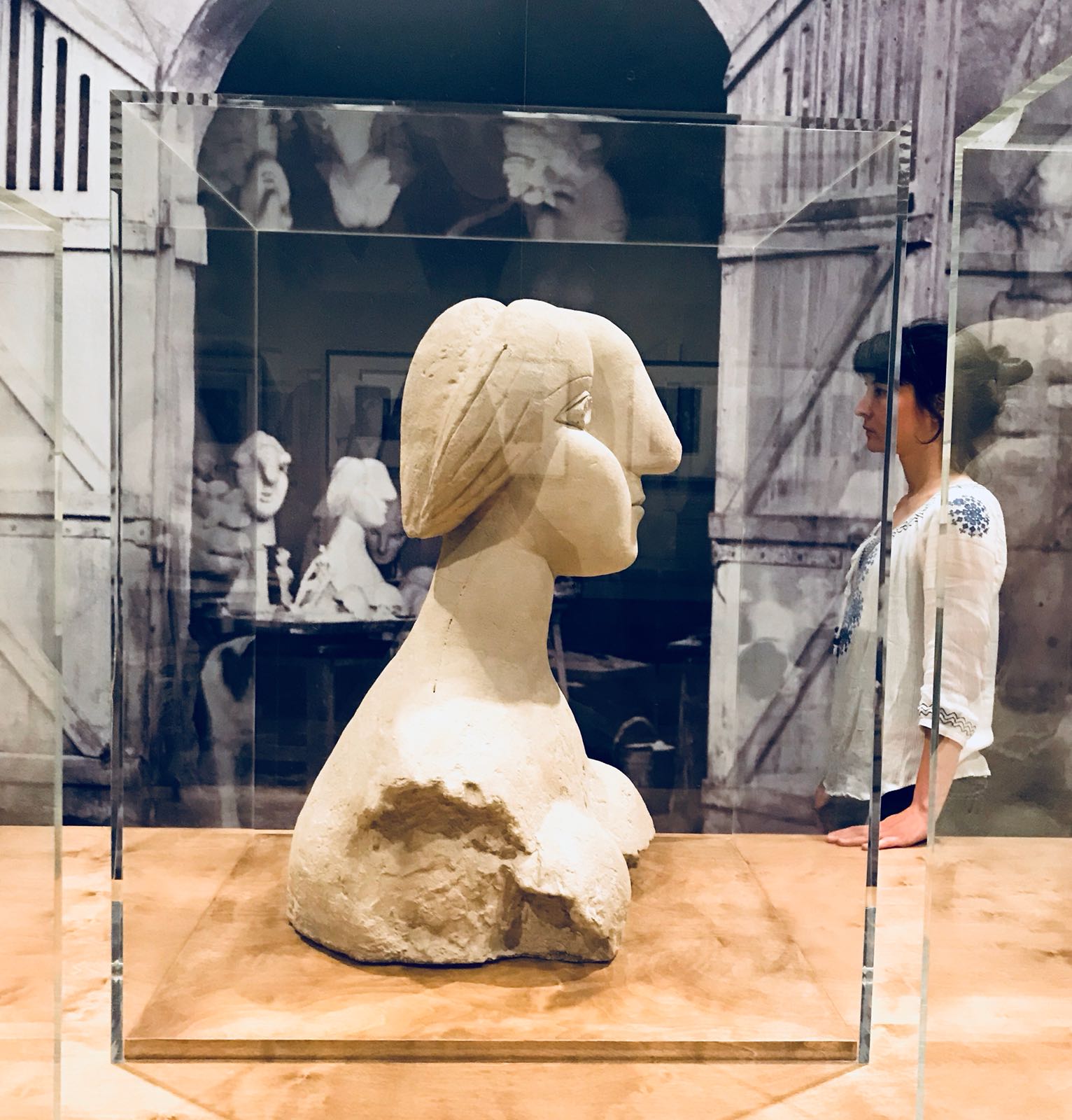
Some of Picasso’s most iconic and beloved works—such as Nude Woman in a Red Armchair from the Tate collection, Girl Before a Mirror from The Museum of Modern Art in New York, and The Dream—are displayed in this show. I also enjoyed seeing two of the sculptures created in Boisgeloup: a large bust of Marie-Thérèse and The Cock, a rare example among his many female figures. It shares their sweeping curves and includes a profile beneath the tail feathers. The original plaster was cast in bronze in 1952. One of The Art Berries’ photos captures The Cock and adds another profile to it.
I enjoyed this exhibition because, at a time when critics were questioning his ability to create new work, he once again redefined the tradition of Western art with a new style full of sensuality, fluidity, and vibrancy—something only a great artist can do.
You can see us below interacting with the artworks at the exhibition.


Leave a Reply