
Eugenio Dittborn: Airmail Paintings
Goldsmiths Centre for Contemporary Art (CCA), London, UK
17 Sep–12 Dec 2021
The last exhibition I saw at Goldsmiths CCA (London) was devoted to Eugenio Dittborn, and I’m genuinely grateful to the person at reception who recommended it. I hadn’t planned to see it that day, but after walking through the show and letting it settle in my mind, I realised just how sharply it resonates with our present moment—and with the restrictions we’ve been living under during the pandemic. If you have the chance, visit before 12 December.
This is Dittborn’s first exhibition in the UK since 1993, bringing together both historical and recent works, all sent to the gallery via courier using his signature airmail method. Since the 1980s, the Chilean artist has produced large-scale pieces that he folds and ships in airmail envelopes to institutions across the globe, sidestepping limits imposed by borders, authoritarian governments, geographical distance, and now a global pandemic. In fact, due to Covid restrictions, Dittborn was unable to travel to the UK for the installation of his own exhibition.
Having lived through Pinochet’s dictatorship—years marked by profound constraint—Dittborn turned to vast sheets of paper and fabric that could be folded into envelopes, creating artworks that examine movement, oppression and freedom. Crucially, these works could be mailed, escaping the very restrictions that shaped their context.
Dittborn originally worked with brown Kraft paper before shifting to fabric. He reproduces found images, texts and drawings sourced from newspapers, magazines, instruction manuals and books. Each, he says, was chosen because it “amazed, disturbed, frightened, and sometimes tickled me.” Unfolded across decades, these pieces now function as documents of personal and national histories.
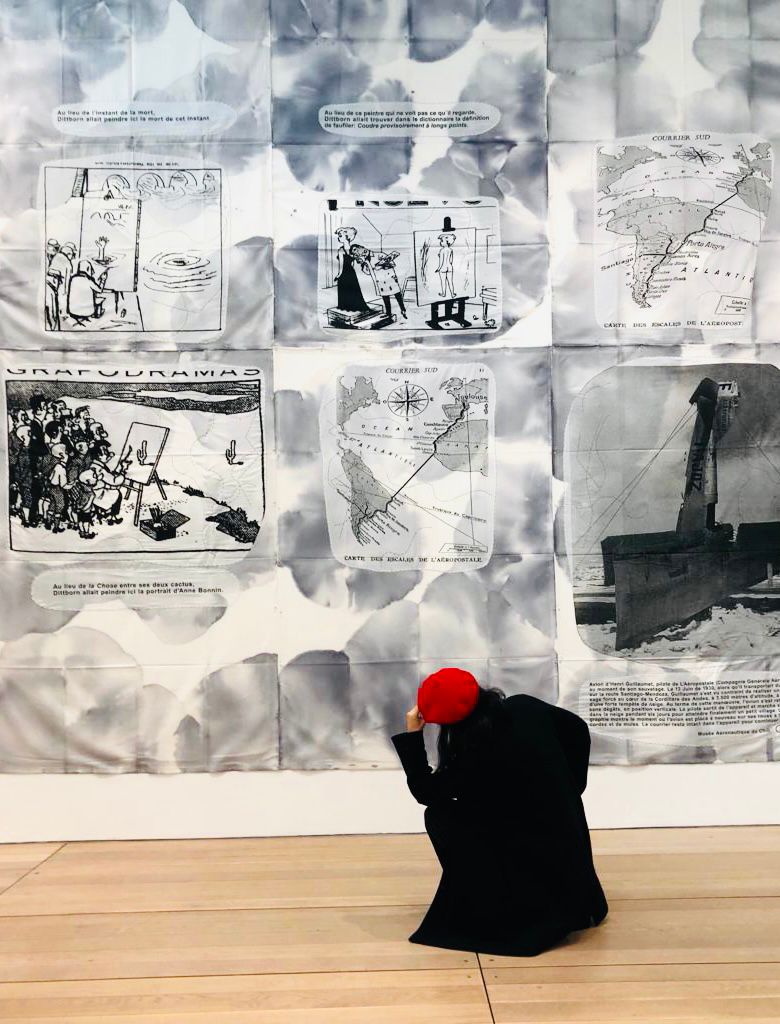
Every work in the exhibition retains the grid of its folds and is displayed alongside the envelope in which it travelled. One piece is covered with photographs of Indigenous Chileans who disappeared under Pinochet. Historia del Rostro (History of the Human Face), an ongoing series, confronts visitors immediately: the direct gaze of these men and women stopped me in my tracks as I entered the first room.
Another work features news photographs of a postal plane that crashed in the Andes. Yet another shows an Indigenous Chilean who was purchased for the price of a few buttons and taken to London aboard the Beagle alongside Charles Darwin.
It’s no coincidence that I wore a red beret in my photos. It reminds me of the Phrygian cap—different in shape, but connected symbolically. As I’ve written previously, Anatolian peoples once wore these caps, and today they stand for the pursuit of liberty.
Restrictions, for different geopolitical reasons, have long shaped the lives of people around the world. Dictatorships control life at countless levels. But by folding his paintings and sending them across continents, Dittborn grants his ideas a freedom that his subjects were never afforded. As he writes on one of his envelopes, he uses airmail to “conquer isolation and international confinement.”
With pandemic-era travel limitations still in place—and with curtailed freedoms persisting in many parts of the world—Dittborn’s airmail works continue to rebel against the system, remaining as resonant and urgent as ever.


Leave a Reply