
Turner Prize 2018
Tate Britain, London, UK
26 September 2018 – 6 January 2019
If you’re in London this Christmas and looking for an art exhibition to visit, the Turner Prize is definitely worth your time. One of the world’s best-known awards for contemporary visual art, it consists entirely of film, video and moving image works this year. To see all four pieces in full, you’d need more than 4.5 hours — though I’ll admit we didn’t stay that long. Moving image allows for a more flexible kind of viewing; it doesn’t have to be as linear or committed as going to the cinema.
I wasn’t surprised to find that all four shortlisted works shared a similar approach. This year’s prize really does capture the mood of the present moment: moving image used as a vehicle for political urgency.
The exhibition is arranged across four darkened rooms, all connected to a central lounge-like space filled with sofas and printed material — slightly reminiscent of a dentist’s waiting room, oddly enough. Still, I liked this setup. After each immersive, pitch-black screening, returning to a bright, open space felt welcome and grounding.
On one side we have Forensic Architecture, a multidisciplinary collective based at Goldsmiths and composed of architects, filmmakers, lawyers and scientists. Their work blurs the boundary between art and investigative research, focusing on allegations of state violence. They do not consider themselves an art group, and they prefer real events as their subject matter. Their Turner Prize piece reconstructs a 2017 night in which Israeli police attempted to clear a Bedouin village — an operation that ended with two deaths. The film is stressful to watch, and clearly just as stressful to make; the team put themselves at risk in the process.
Next, Naeem Mohaiemen departs from strict documentary to create a fictional work in which a solitary man wanders through the ruins of an abandoned airport, like a character straight out of J. G. Ballard. The piece is loosely inspired by his father’s experience being stranded for nine days at a Greek airport decades ago. Through films, installations and essays, Mohaiemen’s practice unpacks political tensions of the 1970s and the legacies of decolonisation. This particular film feels beautifully surreal.
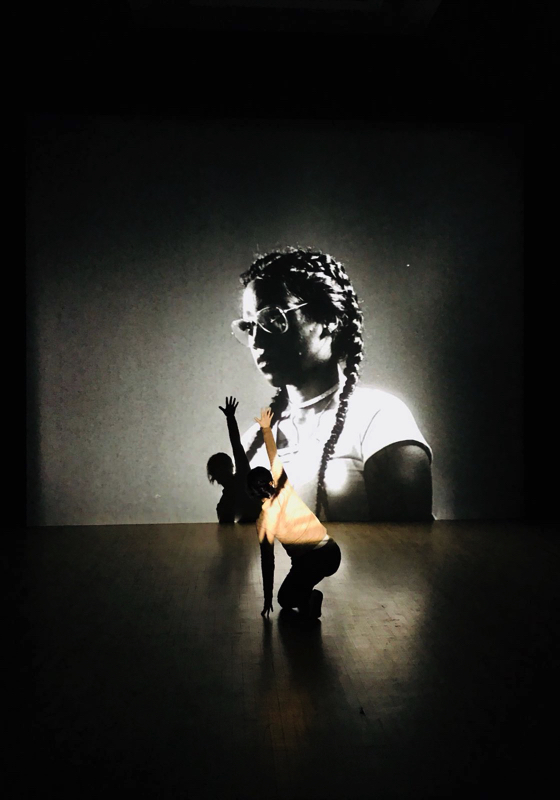
Thirdly, we saw Luke Willis Thompson’s piece. Working across film, performance, installation and sculpture, Thompson examines institutional violence, race, class and social inequality. His contribution was a controversial 35mm film portrait of Diamond Reynolds — the woman who used her phone to livestream on Facebook the killing of her partner by police in Minnesota in 2016. We were drawn to this silent, austere work, and The Art Blackberry even interacted with it, adding another layer to the experience (as you can see below). The presence of a 35mm projector made the piece feel more physical and immediate, and therefore emotionally powerful.
Finally, we encountered the work of this year’s winner, Charlotte Prodger — though she hadn’t been announced as the winner yet when we visited. Working with moving image, sculpture and printed imagery, Prodger explores queer identity, landscape, language, technology and time. She has also been selected to represent Scotland at the Venice Biennale. Her film, shot entirely on an iPhone, is poetic and quietly captivating. I enjoyed this one as well.
The last two works were my favourites: Luke Willis Thompson for his stark, controversial message conveyed through the rich materiality of 35mm film, and Charlotte Prodger for her intimate, poetic iPhone piece, which is something many viewers will easily connect with.

Leave a Reply