
Auguste Rodin: The making of Rodin
Tate Modern, London, UK
18 May – 21 November 2021
I was genuinely excited to see what Tate Modern had prepared for The Making of Rodin, as he has long been one of my favourite sculptors. More than a decade ago, I visited the Musée Rodin in Paris and was struck by the sheer beauty of seeing his work in such an exquisite setting. The small palace, surrounded by serene gardens, had once been his residence, and walking through its rooms—filled with sculptures—felt like stepping into a living, breathing world built by Rodin himself.
The Tate exhibition wasn’t as immersive or enchanting as the Paris museum, yet it offered something different: a deeper understanding of Rodin’s process and artistic evolution. The show focused on the importance of plaster in his practice. Although he is best known for his bronze and marble sculptures, Rodin worked extensively as a modeller in more modest, pliable materials such as clay and plaster—materials that allowed him to capture movement, light and volume with remarkable immediacy.
Rodin (12 November 1840 – 17 November 1917) is widely regarded as the father of modern sculpture. Trained in a traditional academic manner, he approached his craft with the precision of an artisan, yet he possessed an extraordinary talent for modelling complex, energetic surfaces in clay.
Part of the exhibition recreated the atmosphere of his studio, presenting plaster casts in various sizes to illustrate how he experimented with fragmentation, repetition and the recombination of forms in unconventional ways. The curators clearly sought to align Rodin with the lineage of modern and contemporary artists—like Duchamp and Warhol—who embraced appropriation, seriality and the breaking of artistic norms.
The exhibition aimed to show how these studio experiments informed some of Rodin’s most iconic sculptures. But for me, what resonates most deeply in Rodin’s work is not the formal experimentation, but the emotional intensity—his unmatched ability to infuse human figures with vitality, tension and psychological depth. Fragmentation itself was not uncommon in the 19th century; what distinguished Rodin was the expressiveness he extracted from it.
The first room offered an insightful introduction to his artistic development. His male nude The Age of Bronze was particularly controversial at the time. Rodin modelled the figure with meticulous observation, studying his subject—a young Belgian soldier named Auguste Neyt—from every angle. The result was so lifelike that critics accused him of casting the sculpture directly from the model rather than shaping it by hand.
Rodin was deeply offended by these allegations. He even commissioned photographs of Neyt to demonstrate the anatomical differences between the man and the sculpture. The accusation marked a turning point in his career. Soon after, he broke away from the conventions of classical sculpture and idealised beauty, establishing the foundations of the modern sculptural language that would define his legacy.
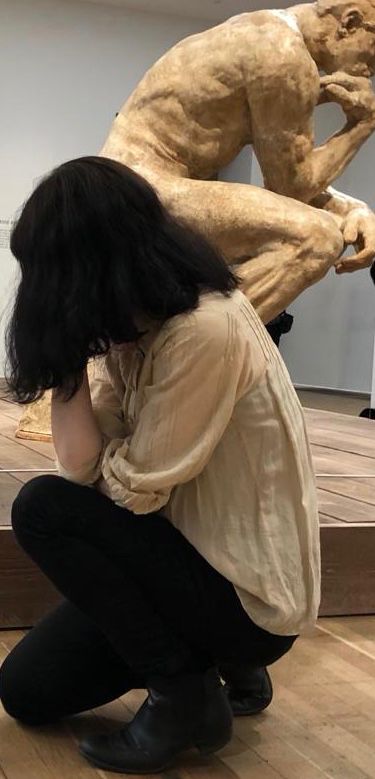
From that moment forward, Rodin sought to create new representations of the human body—ones that reflected the complexities, anxieties and individuality of a rapidly changing world. His goal was not to uphold tradition but to capture essence and emotion. Works such as The Burghers of Calais, Monument to Balzac, The Thinker, and his portrayals of the Japanese actress Ohta Hisa and the aristocrat Helene von Nostitz all reveal his commitment to physicality, presence and expressiveness.


Leave a Reply