
Rachel Whiteread: Internal Objects
Gagosian gallery, Grosvenor Hill, London, UK
April 12 – June 6, 2021
This exhibition at Gagosian gallery is by one of my favourite British artists, Rachel Whiteread. I previously covered her retrospective at Tate Britain a few years ago, so returning to her work felt like revisiting a familiar artistic language.
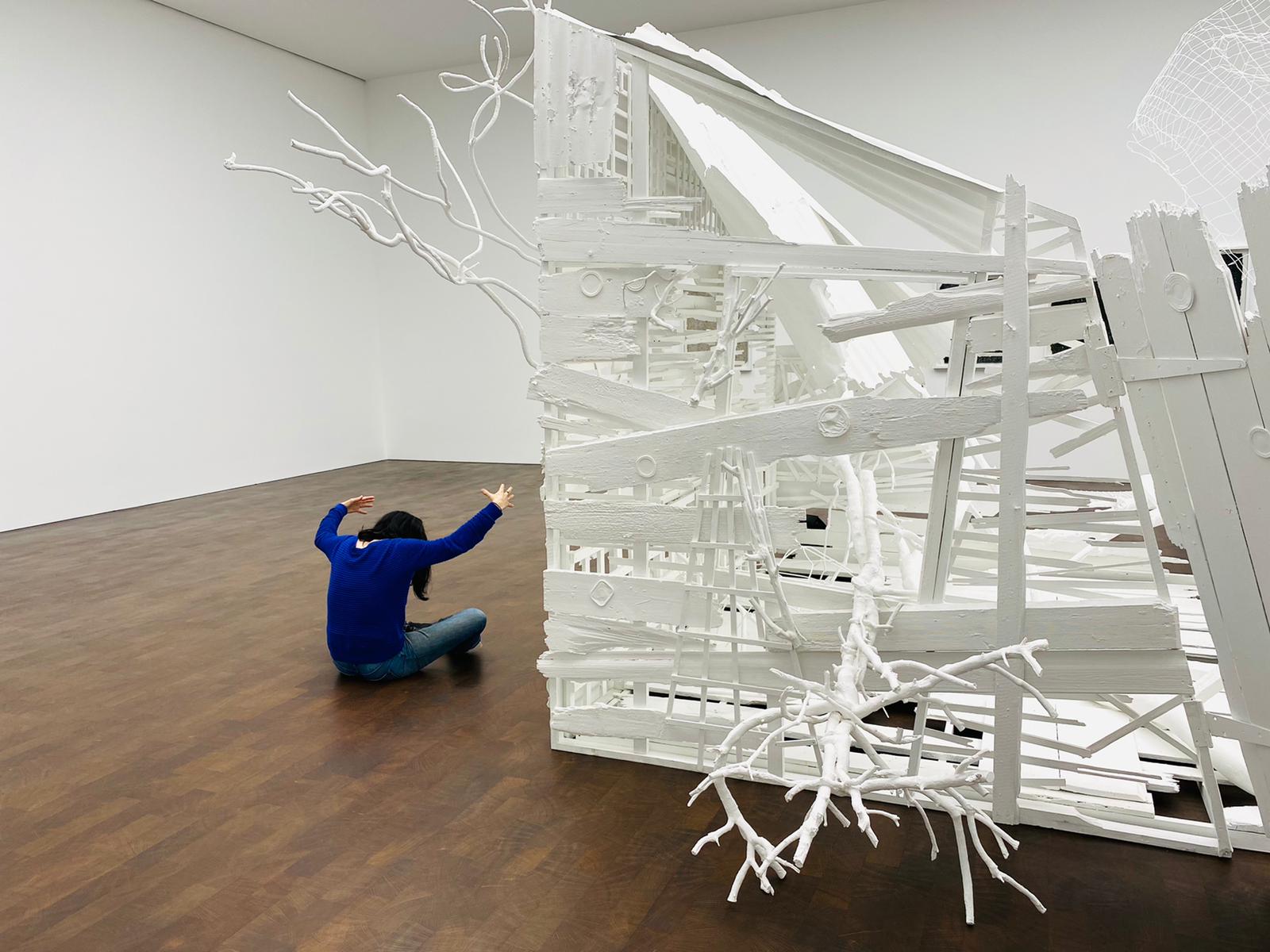
For the past forty years, Whiteread has been known for using casting—working with a range of materials and scales to explore traces of corporeal presence and to give form to the negative spaces of everyday objects. In Internal Objects, however, she departs from this signature method. The major works in the exhibition (see Photo 1) are not casts at all; instead, she constructs original objects from found wood and metal, which she then overpaints in white. The result is striking, but for me these pieces felt as though they had moved away from the essence of what once defined her practice—the recreation of interior, unseen worlds.
That said, I always appreciate when artists venture into new territory to express themselves differently and communicate fresh ideas to their audiences. This is something Whiteread herself reflects on in the excellent video conversation available on Gagosian’s website, where she speaks with Iwona Blazwick, director of the Whitechapel Gallery. Together they discuss the shift in Whiteread’s work: her earlier sculptures were solid and impermeable, while the new pieces feel permeable, fragile—almost as if they have survived some catastrophic event. For these recent works, Whiteread has gathered discarded materials, rubbish, scraps of wood and metal, and reassembled them into structures that carry a sense of resilience.
The exhibition also included works more closely aligned with her earlier processes, such as the pink and blue papier-mâché flags cast from corrugated iron (Photo 2). The papier-mâché was made from her children’s old school books, again emphasising her interest in repurposing detritus and giving it a second life. I was particularly drawn to the aesthetic qualities of these pieces, as well as the impressions made on cardboard (Photo 4), which she first cast in cardboard, then in wax, and finally in bronze. The earlier works in this sequence evoke the residue left behind after a flood—fragile traces of what once was.
The contrast between Whiteread’s earlier and newer practices is beautifully framed in the video through the discussion of two foundational artworks: Piero della Francesca’s The Baptism of Christ and Théodore Géricault’s The Raft of the Medusa. The first evokes serenity and stillness, much like Whiteread’s earlier casts, while the second conjures the sublime and the catastrophic—qualities that seem present in her most recent constructions, which feel marked by turbulence or even violence. And yet, despite the chaos we generate as human beings, nature always survives. It remains humble, persistent, and resilient—a thought that leaves me with a sense of hope.
Finally, the video also includes Mark Waldron reading his poem In a Wayward Place and a performance by Max Richter of Origins (Solo), an original composition from his 2021 album. Both are well worth listening to and beautifully complement the themes of the exhibition.


Leave a Reply