
Rachel Whiteread
Tate Britain, London, UK
12 September 2017 – 24 January 2018
Rachel Whiteread is one of Britain’s leading contemporary artists and my favourite among the YBA generation. Her recent exhibition at Tate Britain charted the trajectory of her career over three decades, from 1988 to the present. Throughout this period, she has been casting what she calls negative spaces using materials such as plaster, resin, rubber, concrete, metal and paper. But what are Whiteread’s “negative spaces”? They are the air that surrounds our daily experience—the interior spaces of familiar objects. We find them in our homes: inside toilet paper rolls, beneath chairs, or within the mattress we sleep on each night. Through her sculptures, Whiteread makes these “empty” spaces solid.
The original idea draws from Bruce Nauman’s work A Cast of the Space Under My Chair (1965–68), which Whiteread referenced in the exhibition with Untitled (One Hundred Spaces) (1995), installed across the south end of the Duveen Galleries at Tate Britain. The work consists of one hundred casts of the undersides of chairs in varying shades of coloured resin, each containing its own imperfections. Yet Whiteread has taken the concept much further.
Her practice ranges in scale from the modest to the monumental, often embracing paradox: capturing human history and wear through geometric forms, minimalism and stark material presence.
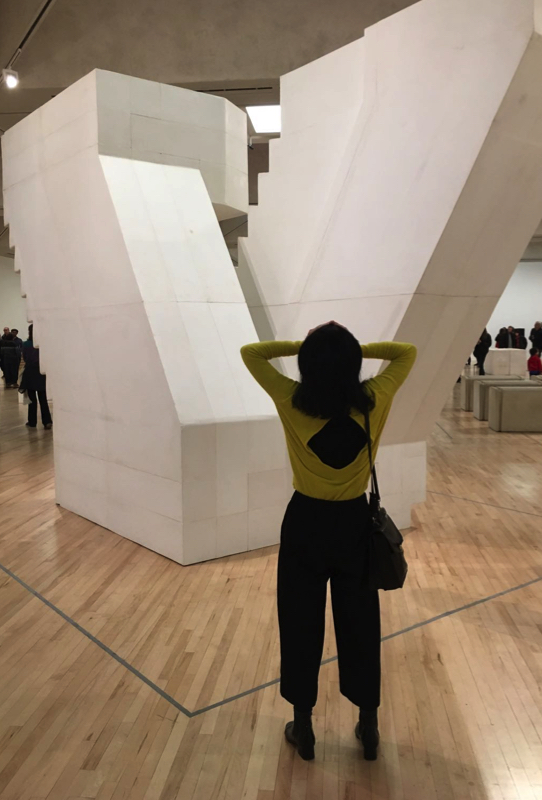
Tate Britain presented many of Whiteread’s most significant large-scale sculptures, including Untitled (Book Corridors) (1997–98) and Untitled (Stairs) (2001)—both of which I photographed here—alongside more intimate works made from domestic objects such as tables, boxes and hot-water bottles. At the heart of the exhibition stood Untitled (Room 101), the plaster cast of a BBC office building demolished in 2003, said to have inspired George Orwell’s torture chamber in Nineteen Eighty-Four.
I first discovered Whiteread’s work in 2005 and have been captivated ever since. That year she filled the Turbine Hall at Tate Modern with Embankment, a vast labyrinth-like sculpture made from 14,000 casts of the interiors of different cardboard boxes. She chose the box for its associations with storing personal belongings and for the sense of mystery surrounding what a sealed container might hold.
Born in London in 1963, Whiteread studied painting at Brighton Polytechnic and sculpture at the Slade School of Fine Art. She became the first woman to win the Turner Prize in 1993 and represented Britain at the 1997 Venice Biennale. She first came to public attention with House (1993), her inaugural public commission: a concrete cast of the interior of an entire Victorian terraced house, complete with impressions of doors, windows and fireplaces. Although it stood for only a few months before its demolition, House announced the beginning of Whiteread’s enduring artistic project—fusing domestic narratives with brutalism and minimalism.
The Tate Britain exhibition was curated by Ann Gallagher and Linsey Young. Co-organised with the National Gallery of Art, Washington—where it will be shown in autumn 2018 and curated by Molly Donovan—it will also travel to the 21er Haus in Vienna and the Saint Louis Art Museum.
You can find me below interacting with the Rachel Whiteread’s artworks as The Art Blueberry.


Leave a Reply