
Cornelia Parker
Tate Britain, London, UK
19 May 2022 – 16 October 2022
You cannot miss the art show of the season in London: Cornelia Parker at Tate Britain. The British conceptual artist is 65 and one of the most recognisable and acclaimed contemporary artists working today. Perhaps this exhibition was long overdue.
From all her body of work, my favourite pieces are her installations. Poetic and mesmerising, they catch your imagination and invite reflection. The artist enjoys playing with concepts, using visual metaphors to investigate the nature of violence, ecology, national identity and human rights.
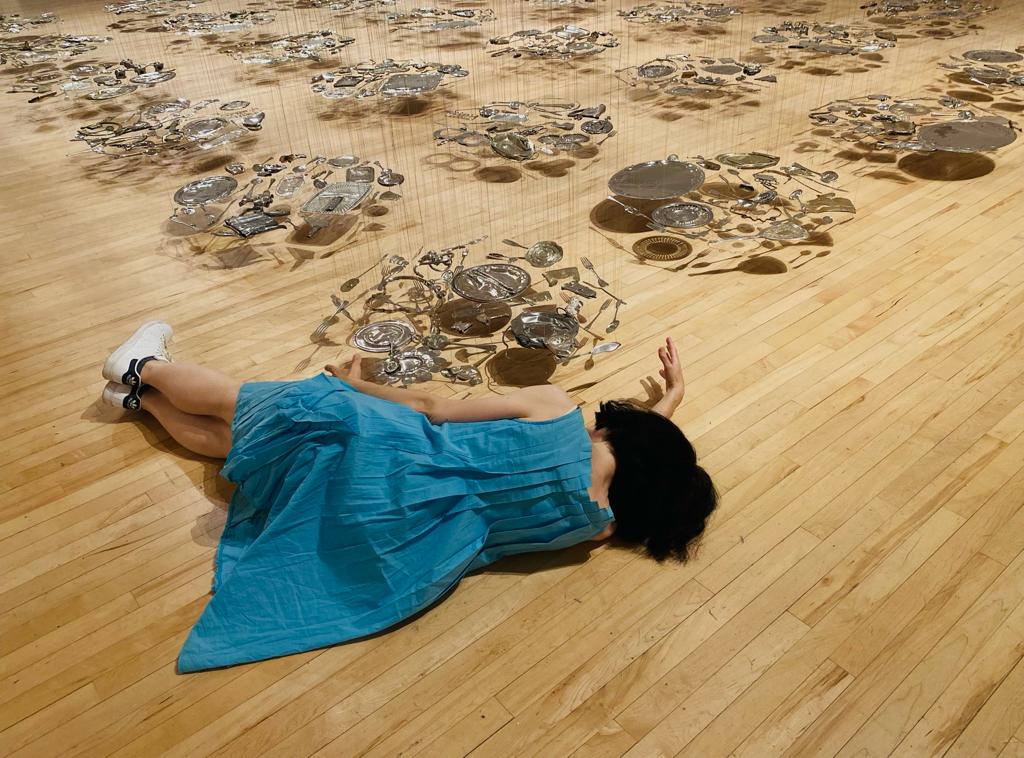
The art show opens with the enthralling Thirty Pieces of Silver (1988–89): thirty groups of silverware hovering inches above the ground in darkness. Parker steamrollered them to take away their volume, leaving them as flat as the cartoonish deaths in the Road Runner animations we watched when we were kids.
The artist speaks of the anxiety she felt when creating this work, knowing her East London home was going to be demolished to make way for the M11 link road. Could that have contributed to the urge for destruction she experienced before making the piece? The work’s title was taken from the Bible, as thirty was the number of coins Judas received for betraying Jesus. I loved seeing these silver pieces from a different perspective, completely flat and hanging from the ceiling. They feel like remnants of an old empire, a memory of better times we now recall with nostalgia.
Another major installation in the exhibition is Cold Dark Matter: An Exploded View (1991), a shed she blew up with the help of the British Army. Parker reconstructed it mid-explosion as a frozen moment of vandalism. The shadows cast on the walls are as important as the work itself, contributing to the sensation that we are part of a larger cosmos.
And again, flattened silver appears in another dimly lit room full of suspended trombones and trumpets in Perpetual Canon (2004), arranged in a circle like a ghost band in a different dimension.
Another installation I found interesting for its originality was War Room (2015): a space lined with rolls of red paper, perforated where poppies had been punched out. The absence of the poppies is deeply meaningful, echoing the many people who went to war and never returned. This work was created by Parker in response to an invitation to produce a piece about the First World War. The tentlike structure was inspired by the pavilion Henry VIII built for a peace summit with the French king in 1520. The peace lasted only a year—hardly a success.
The exhibition also includes multiple works through which the artist tells stories about things that matter to her, often with irony. Among them are photographs of marks left by workmen repointing the perimeter walls of Pentonville Prison, which resemble an abstract painting. The walls were painted white soon after, and a few hours later a murderer escaped by scaling them. Another example: the black-and-white images taken with a camera that once belonged to Auschwitz commander Rudolf Höss.
Parker’s work is also an art of collaboration, such as the embroidery of the Wikipedia entry on the Magna Carta, whose lettering was sewn by prisoners and professional embroiderers, including Edward Snowden and Julian Assange.
Despite the occasional artificiality or excessive logic applied to her work, I like the way she constructs and deconstructs, destroys and remakes the objects and environments around us, inviting us to consider deeper meanings and connections that link us all in the universe.


Leave a Reply