
Citra Sasmita: Into Eternal Land
The Curve, Barbican Centre, London, UK
30 January – 21 April 2025
I’m always pleased to discover new artists with a meaningful story to tell. For the past three months, The Curve at the Barbican Centre has hosted the first UK exhibition of Indonesian artist Citra Sasmita. Although today is the final day, I didn’t want you to miss it.
Sasmita draws on traditional elements, myths, and iconography from ancient Balinese culture and literature to trace the often-marginalised narrative of women in Balinese society. Into Eternal Land speaks to both universal and urgent concerns: reconnecting with ancestral traditions, grappling with the fragility of the natural world, and imagining the possibility of feminist resistance.
Through painting, installation, embroidery, and scent, she explores themes of ancestral memory, ritual, and migration. Sasmita draws from the long histories of displacement across the Indonesian archipelago, taking inspiration from stories that span heaven, earth, and hell – from the Hindu epic Mahabharata to Dante’s Inferno.
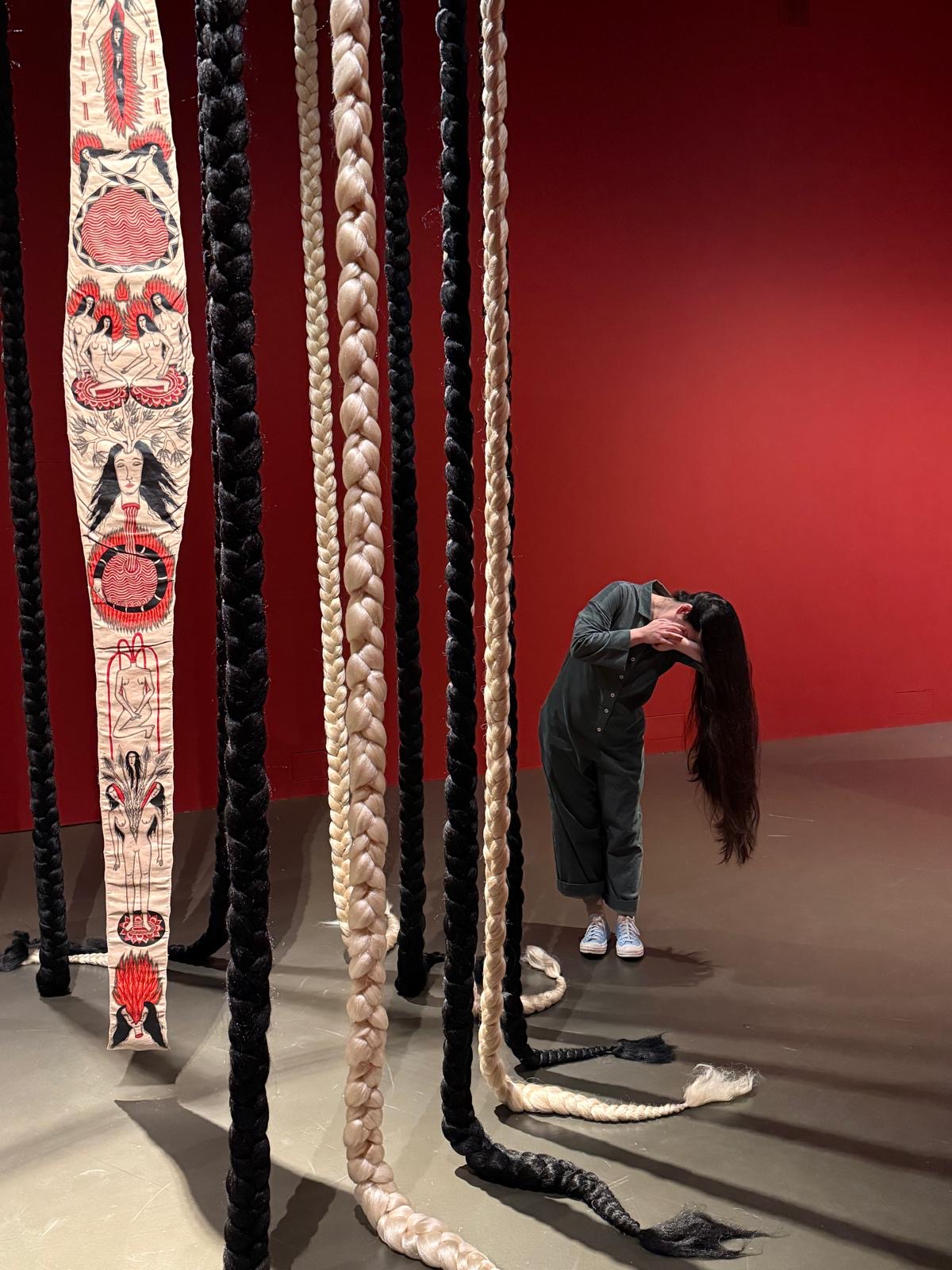
The exhibition unfolds in several acts. Panoramic scroll paintings depict women undergoing transformation and rebirth, while embroidered textiles – created in collaboration with women artisans from West Bali – honour the legacy of traditional women herbalists. The exhibition concludes with a meditative space centred around a golden mandala made of ground turmeric.
Dim lighting, hanging artworks suspended from the ceiling, and the scent of turmeric enrich the immersive experience. It feels like stepping into a sacred space, inviting you to slow down and reflect. This is art with a social message – one that encourages deep contemplation.
Sasmita often works with the Kamasan painting technique, which dates back to the 15th century and was traditionally practiced exclusively by men to narrate Hindu epics. By reclaiming this masculine art form, she dismantles misconceptions about Balinese culture and confronts its violent colonial history.
Historically, Kamasan paintings depicted women as sexualised figures, defined by reproduction, or cast as villains. Sasmita reclaims this tradition, placing powerful female figures at the centre of her work – women who inhabit a post-patriarchal world. Through this, she challenges gender hierarchies and reimagines mythology with a feminist lens.
Born in Bali in 1990, Citra Sasmita is a self-taught artist. Though she studied literature and physics, she never formally graduated from an art institution. Before developing her broader artistic practice, she worked as a short story illustrator for the Bali Post.
Visiting this exhibition was a mesmerising experience – a journey of discovery through ancient technique and contemporary meaning. It’s a reminder that artists can bridge the past and present, reinterpreting age-old narratives with modern sensibilities while preserving cultural heritage.
The exhibition resonated with me on a more intimate level, perhaps because I’m a woman. The hanging plaits, arranged with a near-ritual delicacy, alongside the presence of symbolically powerful female figures, felt like a long-overdue homage to forgotten Indonesian women — who, at last, seem to be receiving the recognition that was denied to them for so long.


Leave a Reply