
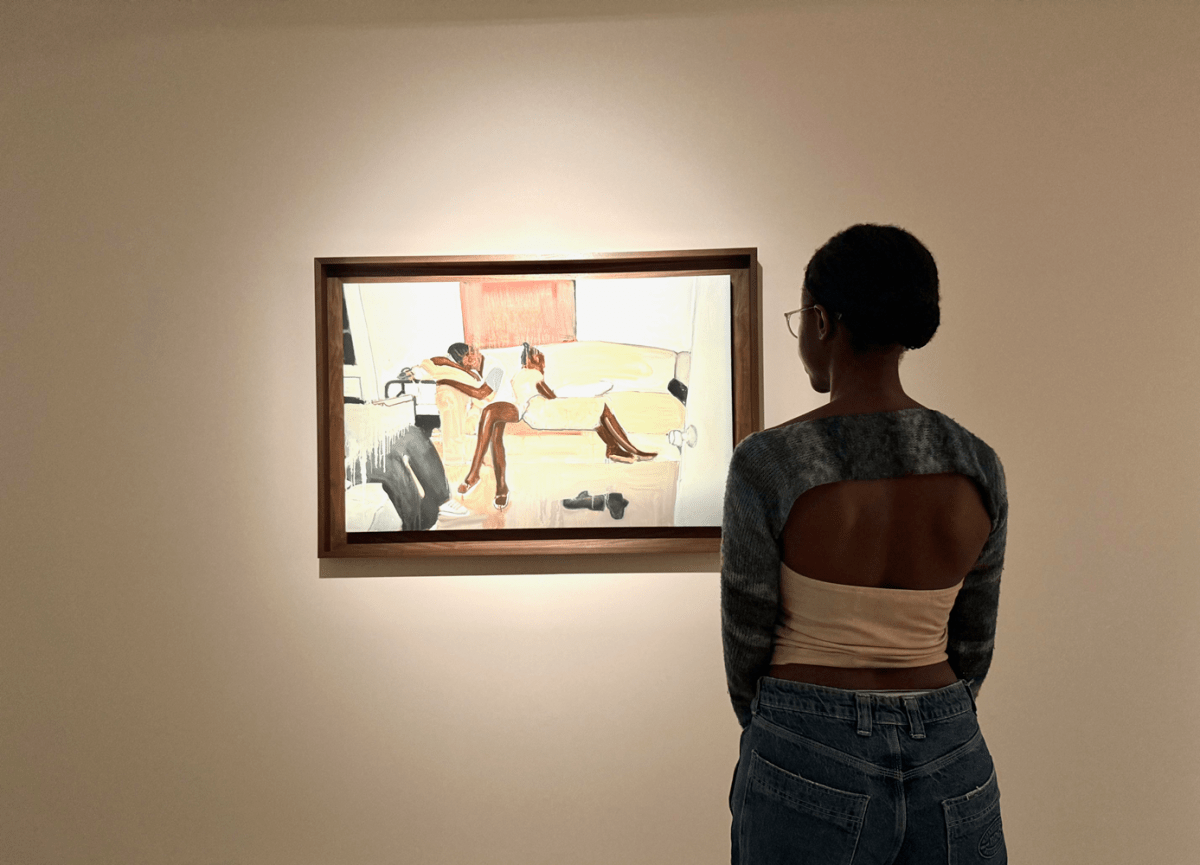
Noah Davis
Barbican Art Gallery, Barbican Centre, London, UK
Thursday 6 February – Sunday 11 May 2025
This post is about the current exhibition at the Barbican gallery that is ending this weekend, and it’s certainly worth a visit. Noah Davis was an American artist (1983–2015) that I find truly inspiring and with which I share the same vision of creative togetherness. He believed art was for everyone and I totally support that vision.
Davis blended historical and contemporary source material to create images of Black life that are unbound by a specific time or place. His figurative paintings explore the emotional, and fantastical, textures of everyday life. Davis painted figures diving into pools, sleeping, dancing, and looking at art in scenes that can be both realistic and dreamlike—some joyful, others melancholic.
As Noah Davis once said, “Painting does something to your soul that nothing else can. It is visceral and immediate.”
Davis drew from anonymous photography, personal archives, film, art history and his imagination to create a ravishing body of work. Often enigmatic, his paintings reveal a deep feeling for humanity and the emotional textures of the everyday. Davis agilely moved between painting styles, often using unorthodox techniques and a diverse palette.

Davis understood the power of art to uplift others and believed art was for everyone. In 2012, he and Karon Davis, his wife and fellow artist, co-founded the Underground Museum, a revered and much-loved institution in the historically Black and Latinx neighborhood of Arlington Heights, Los Angeles.
In his lifetime, Davis used the Underground Museum as a studio, a site for residencies and an exhibition space, convincing the Museum of Contemporary Art, Los Angeles (MOCA) to lend their collection in a three-year partnership starting in 2014. By the time he died in 2015, he had planned 18 exhibitions for the Underground Museum using MOCA’s collection, motivated by the desire to “change the way people view art, the way they buy art, the way they make art.”

The exhibition features groups of paintings made between 2007 and 2015 that chart his interest in politics and current affairs, everyday life, ancient Egypt, family history, the racism of the American media, art history and architecture. The paintings are positioned alongside Davis’s experimentations in sculpture, installation, works on paper and curation, giving special attention to the conceptual underpinnings of his practice, as well as his engagement with the complex histories of representation and image-making.
Born in Seattle, Washington in 1983, Davis had his first painting studio in high school. He briefly studied film and conceptual art at Cooper Union in New York before leaving to pursue his own artistic education. By 2004 he had moved to LA and was working at the bookshop Art Catalogues, where he could feed his appetite for a wide-reaching history of culture and, in particular, painting. Drawing on the legacy of artists ranging from Caspar David Friedrich to Mark Rothko, Romare Bearden to Kerry James Marshall, he developed a distinctive painterly style.


To show Black life with beauty, majesty, joy and humour was both a risk and a necessity; Davis painted at a time of acute racism and systemic violence in the US, where identity was often weaponised as difference through the circulation of images in the media and on newly formed social media platforms.
I particularly enjoyed his dreamlike figurative paintings that appear detached of a specific time or place, and made me think that good art endures time and space and in the memories of its audiences. His wide knowledge of art history and his interest in politics and current affairs apart from everyday life scenes, as well as his deep commitment for inclusion to give free access to world-class art to less favoured communities in LA, make his work very original and relevant to the current political context we’re living these days as well.
Special thanks to our Guest art berry, Damola, for posing for the cover photo.


Leave a Reply