
Anish Kapoor
Hayward Gallery, London, UK
16 June – 18 October 2026
Almost three decades after his first major survey at the Hayward Gallery, Anish Kapoor returns with an exhibition that is both visually spectacular and emotionally unsettling. Monumental installations continue to challenge our perception of space, while more recent works confront us with flesh, ritual and sacrificial imagery. Together they reveal the enduring dualities that have defined Kapoor’s practice, while raising questions about how successfully the exhibition connects these different expressions of the artist’s longstanding concerns.
The retrospective also reflects a broader shift in exhibition-making. As museums compete for increasingly fragmented audiences, the strongest exhibitions rarely rely on a single reason to visit. Kapoor’s survey combines sensory immersion, monumental spectacle, intellectual enquiry and emotional confrontation, demonstrating how contemporary institutions increasingly layer multiple forms of engagement.
Kapoor’s fascination with dualities has remained remarkably consistent throughout his career. Presence and absence, matter and immateriality, body and spirit, attraction and repulsion all underpin his work. Since the early 1980s, his sculptures have explored what he describes as “the space of the object”, inviting viewers to question not simply what they see, but how they experience space itself. Awarded the Turner Prize in 1991, elected a Royal Academician in 1999 and knighted in 2013, Kapoor has become one of the defining figures of contemporary sculpture.
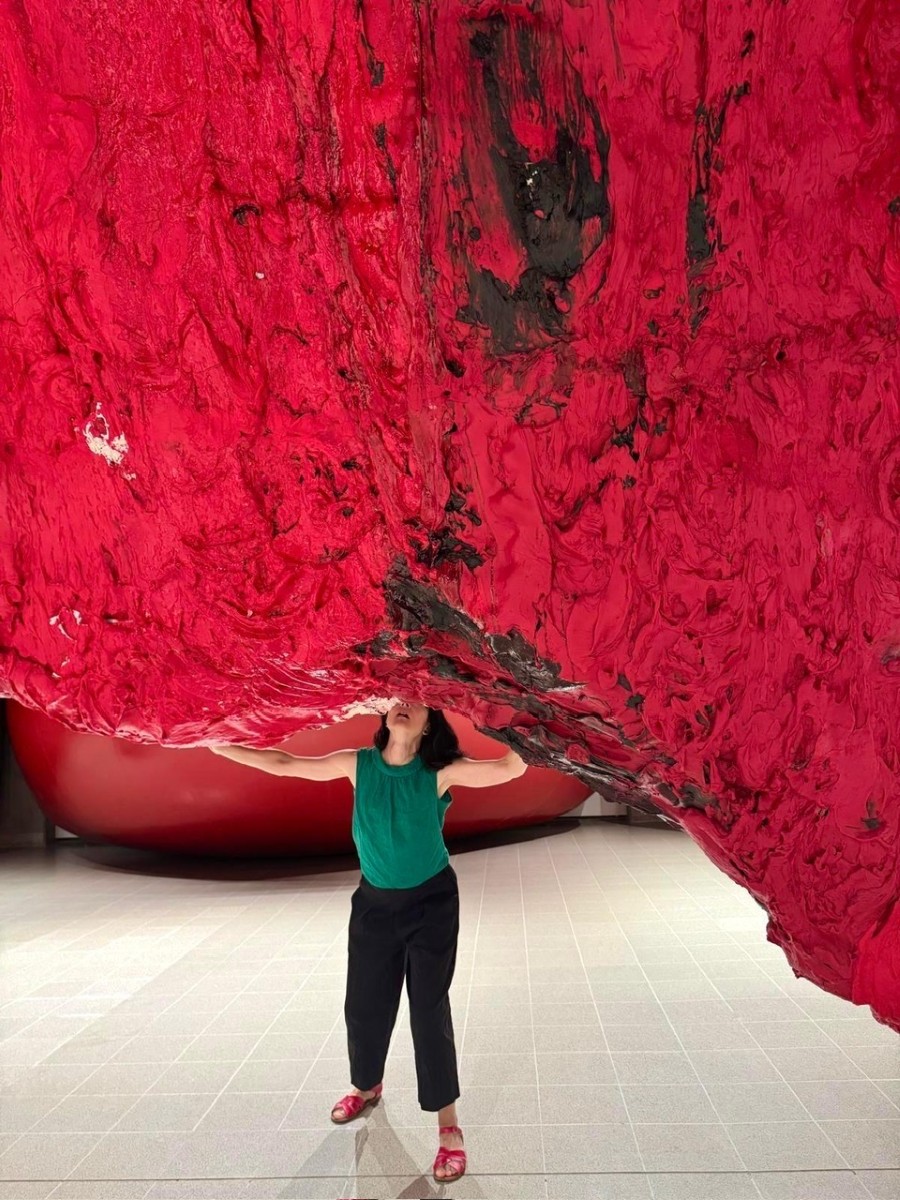
That enquiry is immediately evident in All of Nothing (2026), an enormous inflated PVC membrane that fills the six-metre-high entrance gallery, compressing the visitor between sculpture and architecture. Kapoor describes the work as neither pure sculpture nor pure architecture, but as an encounter in which the body becomes part of the work itself. It is an arresting opening that immediately destabilises our sense of scale and space.

One of the exhibition’s strongest rooms, and my favourite, is devoted to Kapoor’s celebrated voids and Vantablack sculptures. Here, surface and depth dissolve into optical uncertainty. As Kapoor has suggested through his references to Kazimir Malevich’s Black Square, these works occupy a space between reality and illusion, rewarding sustained looking rather than immediate understanding.


The following gallery marks a gradual shift in tone. Works such as Mount Moriah at the Gate of the Ghetto (2022) and Plastic Sacrifice I, II, III introduce a more visceral vocabulary of flesh, blood and ritual sacrifice. Kapoor’s investigation of interiority finds a more corporeal expression, confronting visitors with imagery that is both monumental and viscerally disturbing.


The upper gallery develops these ideas further through Ha Makom. Inspired partly by Kapoor’s encounters with Uluru and drawing on the Hebrew concept of “the place” as a manifestation of the divine, the installation extends the exhibition’s exploration of ritual and transcendence. Despite its physical presence, I found its symbolism less open than the artist’s earlier perceptual works. The mystery remained, but it felt increasingly guided rather than discovered.

Kapoor rejects the idea that these works represent a break with his earlier practice. In a recent interview with The Art Newspaper, he described ritual as “a big part of what I’ve worked with over many, many years”, adding that “the void is one, and this is another”. Rather than abandoning his earlier concerns, Kapoor presents these visceral works as another way of exploring interiority. His lifelong fascination with dualities remains unmistakable.
Yet as a visitor, I occasionally found that the exhibition’s symbolic language, rooted in ritual and sacrificial imagery, became more explicit than the perceptual language that first defined Kapoor’s practice. Rather than allowing meaning to emerge gradually through looking, some works seemed to arrive with their interpretative framework already attached.


Rather than unfolding as a continuous argument, the exhibition occasionally feels like two complementary but insufficiently integrated expressions of the same artistic enquiry. Kapoor has consistently described ritual as central to his practice, from the meditative quality of his early pigment works and voids to the sacrificial imagery of his recent sculptures. Yet the exhibition does not always make this evolution fully legible, leaving visitors to bridge the conceptual distance between contemplation and carnage.
That tension is reinforced on the Hayward’s outdoor terraces, where Kapoor’s monumental mirrored steel sculptures return us to the perceptual investigations that have long characterised his work. Their shifting reflections dissolve architecture into movement and uncertainty, completing the exhibition’s exploration of duality while also highlighting the challenge of integrating its two dominant artistic languages.

Perhaps that unresolved dialogue is itself part of Kapoor’s project. Throughout his career, he has resisted simple oppositions, allowing object and non-object, body and void, certainty and uncertainty to coexist. Kapoor’s enduring exploration of ritual has not changed. What has changed is the emotional register through which that ritual is expressed, shifting from contemplative ambiguity to visceral confrontation. Whether those two artistic languages ultimately deepen one another or remain in productive tension is a question the exhibition deliberately leaves open.
Continue Looking
Much of Kapoor’s work rewards careful observation rather than immediate interpretation. If you’re interested in developing a greater sensitivity to form, scale and spatial composition, this Domestika course explores many of the visual principles that underpin minimalist ways of seeing.
Acknowledgements
My thanks to Ottavia Castellina for the portrait photographs accompanying this review.
Ottavia Castellina Photography →

Leave a Reply