
How exhibitions shape meaning through architecture, history, institutions and curatorial decisions.
Two people can stand in front of exactly the same painting and leave with completely different impressions depending on where they look at it. We usually attribute that difference to personal taste. But exhibitions suggest another possibility: that where we encounter an artwork influences how we see it.
Space is not neutral. It is a co-author. For decades, the white cube gallery promoted the illusion that architecture could disappear, allowing artworks to speak for themselves. Contemporary exhibition-making tells a different story. Architecture, local history, institutional context and curatorial decisions all shape how we experience and interpret art.
This principle underpins The Art Berries. Rather than treating exhibitions as neutral containers for art, we examine how these forces shape the meaning of the works of art they present.
This is not just a theoretical point. These are the fundamental economic and cultural stakes for physical galleries today. In an era where any artwork can be accessed instantly on a high-resolution screen, physical exhibitions lose the monopoly on mere visual access. Their greatest remaining advantage is physical context. And galleries are increasingly aware of it.
The exhibitions we remember are rarely those that simply present artworks well. They create connections between art, place and audience that unlock new layers of meaning. Architecture, local history and curatorial decisions are among the most powerful tools for making those connections.
Learning to recognise these forces changes how we visit exhibitions. Rather than asking only whether the artworks are good, we begin asking why they were brought together here, in this place, at this moment.
If the artwork remains the same, what changes our experience of it? Four factors help explain how place shapes the meaning we take away from art.
1. Architecture as Meaning
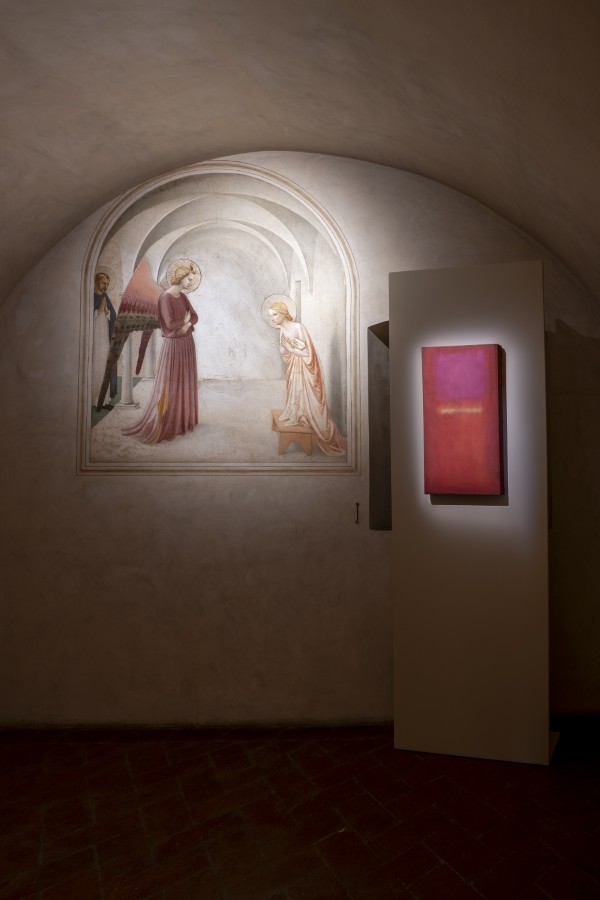
The physical setting creates a lens before the viewer even looks at the canvas. Moving a Rothko from a sterile white cube to a historic Italian palazzo is not just an aesthetic choice; it forces a modern abstract work into conversation with religious history and classical proportion. This becomes particularly evident in Rothko’s retrospective at Palazzo Strozzi in Florence, where the paintings enter into an unexpected dialogue with the spiritual architecture of the nearby Convent of San Marco. We explore this in our review of the exhibition.
2. Local History as Context
An artwork absorbs the unresolved histories of the city hosting it. Anselm Kiefer’s explorations of memory and history read differently in Amsterdam than they do in Berlin, because each city’s history of occupation, guilt and resistance reshapes the meaning of his symbols.
3. Institutional Framing
Institutions shape how we understand value. At Tate Modern, the work is presented as cultural heritage and educational asset. At David Zwirner, the exact same work is framed as an investment asset for private acquisition. The setting tells us whether to contemplate, learn or collect.
4. Curatorial Dialogue
Artworks rarely stand alone. Curators create meaning through relationships, bringing works into conversation across time, geography and culture. Bharti Kher’s fantastical sculptures, for example, take on new resonance when installed alongside classical sculpture at the V&A Museum. They remind us that the history of sculpture is not a single European narrative but one of many possible stories.

An artwork is never experienced in isolation. Architecture, curatorship and institutional history do more than contain it. They actively participate in creating meaning. At its best, an exhibition transforms familiar works into entirely new encounters, reminding us that art and place cannot be separated without changing how the work is understood.
At The Art Berries, we believe exhibitions are conversations between art, place and audience.
If this way of looking resonates with you, explore our exhibition reviews. Each one examines not only the artworks themselves, but also how architecture, place and curatorial decisions shape the experience of seeing them.
Continue the conversation
Read
Rothko’s timeless dialogue with the viewer
Discover how Rothko’s paintings enter into dialogue with the architecture and spiritual history of Florence.
Explore
Europe art exhibitions
Browse our curated guide to some of the most significant exhibitions across Europe this summer.
Further study
Introduction to Abstract Painting (Domestika)
If this article has sparked your curiosity about abstract art, this introductory course offers an accessible way to explore the principles of colour, composition and abstraction through the artist’s perspective.


Leave a Reply