
When Forms Come Alive
Hayward Gallery, Southbank Centre, London, UK
7 February 2024 – 6 May 2024
This is the last weekend that this art exhibition will be open, so I strongly recommend that you go. The show includes contemporary sculpture made in the last 60 years, inspired by movement, fluidity, and growth, and it’s one of the best exhibitions I’ve seen at the Hayward Gallery in years. It’s open until Monday, bank holiday in the UK.
In contrast to traditional sculpture, the works on display in this exhibition are organic and appear to be undergoing a process of transformation. It’s as if art has partnered with science to bring you a new perspective of the world on a grander scale.
Exploring the gallery space was a delight, with each room revealing new artworks and surprises. The curating is brilliant, in terms of the works selected, the space allocated to each of them, and in between them. This allows you to navigate the show and see yourself in relation to these artworks.
As you enter the main gallery space downstairs, you can see the work by Dutch duo Studio Drift, where little silk flowers move open and close as they go up and down in an absorbing dance.
Adjacent to this, you’ll find the striking installation by Michel Blazy, crafted from white foam. Like other forms of ephemeral art, the works evolve and move as you stand in front of them, gaining interesting spiralling shapes that you’d like to be able to touch for their softness and fluidity, as if wanting to be part of that flow. See The Art Blackberry next to Blazy’s work.

Then, up the ramp, you see the towers created out of discarded junk by Seoul-based sculptor Choi Jeong-hwa. The stuff of everyday life is combined here in surprising towers of rusty nails, gas rings, shells, etc., called by him “holobionts”, little microcosms of symbiotic organisms.

This takes us into a room with the artworks created by Spanish artist Teresa Solar Abboud, in which a mix of clay, resin, metal, and acrylic develop into hybrids between biology, geology, and engineering. These ‘Three tunnel boring machines’ combine industrial and organic material in such a magical way that they seem to be presenting you with huge craps elevating their arms to the sky in dynamic and mysterious ways. I was mesmerized by these works. See below The Art Blueberry interacting with them.


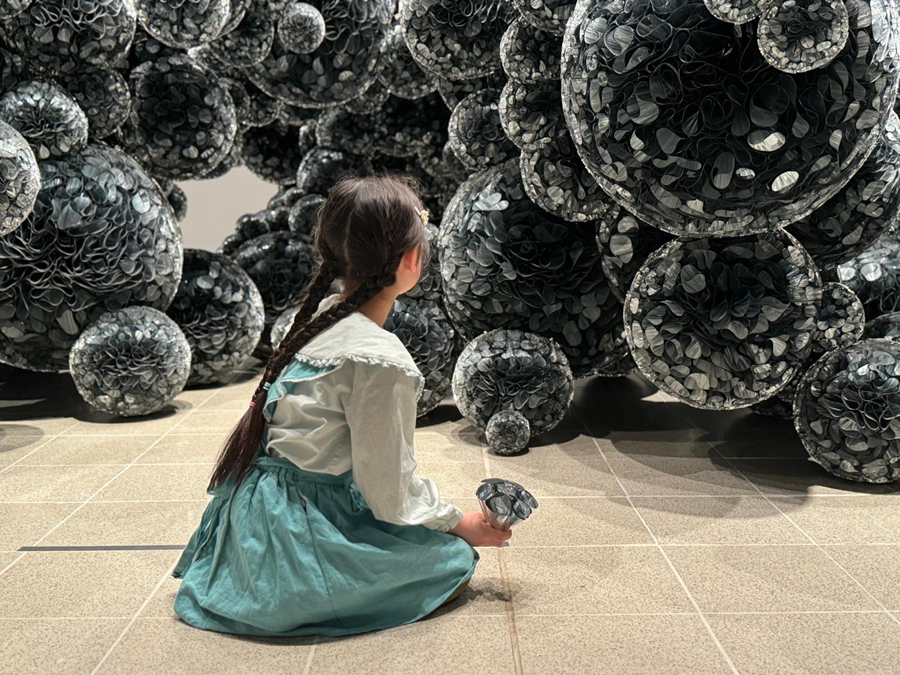
The following artwork is probably one of the most aesthetically exciting in this art show. The work created by the American artist, Tara Donovan, of shiny molecular forms proliferating to fill a whole space. All made of Mylar, a metallic polyester film, which was folded, glued, and massed into spheres of various sizes that resemble huge molecular structures. The Little Art Strawberry posed holding a small part of it fallen from the artwork and offered to her by the gallery attendant. We loved this artwork!

The next amazing installation was by the French artist Marguerite Humeau, and it was made with beeswax, walnut wood, and microcrystalline wax to recreate forms that exist in nature like a tree that spreads flat into clusters of tiered honeycombs and releases a scent, while you can listen to a soft buzz that makes you feel as if you were in the presence of a form that’s still alive. These three pieces of art are mesmerizing and atemporal and are central to the theme of this exhibition.


French art continues to captivate in the following room with another French artist, Jean-Luc Meulene. His works are placed on top of white tables and capture your imagination with vibrant colors and organic shapes with surrealist touches. See the pictures below to get an idea.


While the artworks in the upstairs gallery are equally impressive, they didn’t leave quite the same impact on me as those downstairs. Nevertheless, there are standout pieces worth mentioning, such as Ruth Asawa’s intricate wire sculptures, which draw inspiration from natural forms.

I found captivating the work by American artist Senga Nengudi, who presented a water-filled form that reminds us of the malleable character of human flesh and how our bodies are formed mostly by water. It makes me think of the fragility and endurance of human bodies.

Then, I liked the artwork on Lichen made by London artist Holly Hendry. She brings to life the theme of this exhibition quite perfectly. She works with scale, taking microscopic images of lichen, water, algae, and fungi and transforming them into a sculpture made of stainless steel, glass, canvas, timber, and paint to reveal unexpected connections between natural and architectural forms. She invites us to see the building for this gallery as part of a larger ecosystem.

And finally, I must mention that this exhibition also includes works by other renowned artists such as Phyllida Barlow and Franz West, whom I also found interesting and well-integrated in this exhibition. However, since I have previously covered their works in this blog, I won’t delve into them on this occasion, but you can see two photos below.


The artworks in this exhibition invoke shifting realms of experience and reminded me that everything is in a continuous state of fluxing and change. In these times in which we are somehow disembodied because of the profusion of digital devices around us, these artworks invite us to be present and enjoy our senses.
I feel that art is so close to science when you look at this works, that could have been inspired by the microscopic images taken from a laboratory and recreated in color and exciting materials. You cannot miss this exhibition if you’re in London and free until Monday.
Leave a Reply