
Andy Warhol
Tate Modern, London, UK
12 March – 15 November (Extended)
This post is long overdue, but Covid-19 has transformed our lives in unimaginable ways. Galleries here in London were closed for months, and now they can only be visited by appointment. So I’m finally back to write about the last exhibition I had seen in a long while: Andy Warhol at Tate Modern. The show has been extended until 15 November, so there’s still time to catch it.
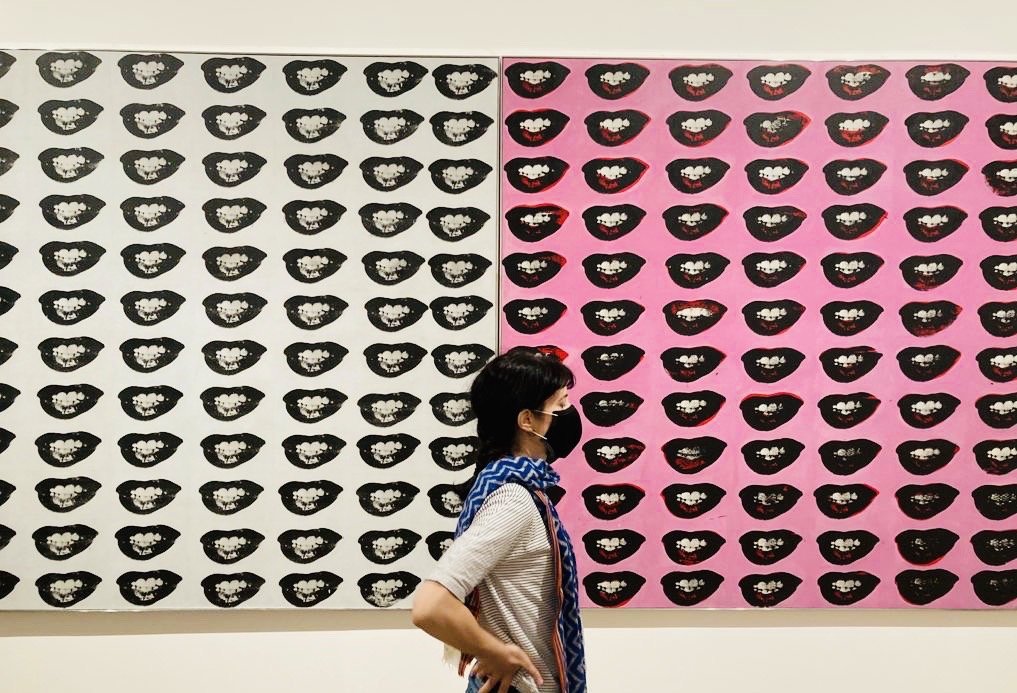
I’m not the biggest fan of Pop Art, but Warhol is an American icon who can’t be ignored. The exhibition brings together some of his most recognisable works — the paintings that made him famous as a Pop artist (a term he apparently disliked): Coca-Cola bottles, fifty Marilyn Monroe portraits (1962), 168 pairs of Marilyn’s lips (with The Art Blueberry posing beneath them in the photo below), Elvis I and II (1963–64), Pink Race Riot (1964), a woman falling from a building 35 times, ten Brillo boxes stacked in a corner, one hundred Campbell’s soup cans, 112 Coke bottles, and Marlon Brando appearing twice, among many others. Warhol was a master of repetition. “I want to be a machine,” he once said — a statement that, in my opinion, enriches the work rather than making it monotonous.


Warhol’s sexuality is also an important thread in this exhibition. It begins with early line drawings of men from the 1950s and includes Sleep (1963), the film documenting Warhol’s lover, the poet John Giorno. It also features large-scale paintings from his 1975 Ladies and Gentlemen series — shown in the UK for the first time — depicting anonymous Black and Latinx drag queens and trans women from New York, including the iconic performer and activist Marsha P. Johnson, a central figure in the 1969 Stonewall uprising. The exhibition reflects Warhol’s attempt to bring the stars of the underground into the mainstream.

One of my favourite works appeared at the very end: Warhol’s reimagining of Leonardo da Vinci’s Last Supper. Silkscreened from a reproduction, it stretches across a panoramic canvas, repeated sixty times in black and white (see image below). Through repetition, Leonardo’s masterpiece becomes something like a static film strip, and it even feels like a subtle homage to Luis Buñuel’s film Viridiana.

Altogether, the exhibition traces Warhol’s experiences as the child of working-class immigrants, a gay man, a devout Catholic and the survivor of a near-fatal shooting — threads that shaped his artistic evolution. His innovative, unmistakable approach to art during a period of intense political, social and technological change has secured his place as one of the most influential artists of the 20th century.
Leave a Reply