
Theaster Gates: A Clay Sermon
Whitechapel Gallery, London, UK
29 September 2021 – 9 January 2022
It’s always good to encounter new artists and new lines of creative expression. Visiting Theaster Gates’s ceramic exhibition at the Whitechapel Gallery earlier this year was precisely that kind of discovery. The exhibition title, A Clay Sermon, powerfully conveys the material and spiritual legacies embedded in clay.
Clay and religion sit at the foundation of Gates’s artistic practice. The Chicago-based artist, internationally recognised for his community and cultural interventions in Black Space, often reflects on the analogy between the potter and the divine. As he puts it, “As a potter you learn how to shape the world.” Art as activism. Activism as art. That is the proposition at the heart of his work.
Gates studied urban planning and ceramics—the latter under traditional artisans more than 20 years ago in Tokoname, Japan. At the same time, he was encouraged to find his own voice. Gradually he developed the concept of Afro-Mingei, fusing Japanese philosophy and folk traditions with African American culture. Many of his early projects explored the shared significance of pottery in both cultures.
The exhibition unfolded across two floors. The ground floor offered context, with loans from institutions including the Victoria and Albert Museum in London. It presented works from China and Iran, alongside historic pieces by some of Gates’s ceramic heroes. Seeing these works side by side provided a rich, informative backdrop.
One of Gates’s key inspirations is David Drake—also known as Dave the Potter—an enslaved man who gained his freedom at the end of the Civil War. Working in potteries in South Carolina, Drake produced vast, commanding vessels, some inscribed with lines of poetry despite laws forbidding enslaved people from writing. He was a Black man exploited by the system, yet he preserved his dignity through craft and creative expression.
Another important reference is the Greek-American ceramicist Peter Voulkos (1924–2002), celebrated as a radical figure in the medium. His fired-clay works engage with Abstract Expressionism, Zen philosophy, and later Pop Art. Gates pairs one of his own sculptures with Voulkos’s large wood-fired stoneware vessel Pinatubo (1994), borrowed from the V&A. The two pieces share a plinth, standing in dialogue. Gates has created several works in homage to Voulkos, in the spirit of utsushi—a Japanese notion of replication as spiritual practice.
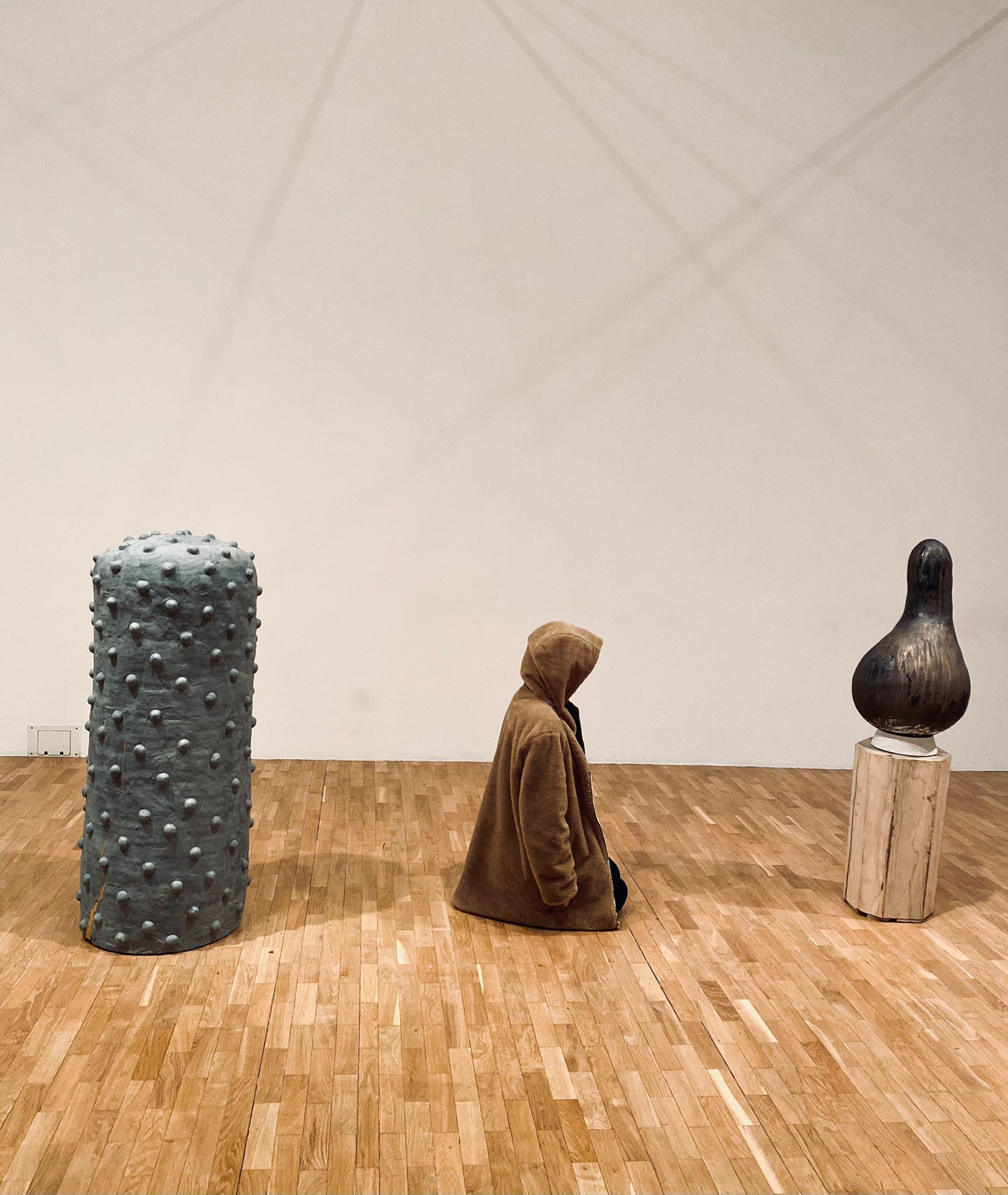
The upper floor was devoted entirely to Gates’s work: large sculptural pieces displayed on and framed by wood and stone, evoking Brancusi while weaving together the diverse influences that shape his practice. I loved the mix—big organic forms like a tall spiky vessel, an Asian-inspired glazed stoneware pot deeply rooted in Afro-Mingei, a chair drawing on African traditions, and several Afro-Mingei faces framed in wood. Our interaction with the works (shared below) felt almost like acknowledging that we, too, are clay.
Throughout the exhibition, themes such as clay’s role in building communities of knowledge, its entanglement with colonialism and global trade, and its ceremonial and ritual uses were thoughtfully explored. Craft and racial identity were also central. Gates is not only skilled in shaping clay; he is profoundly committed to shaping community.
I can’t wait to see Black Chapel, the design he will create for the 2022 Serpentine Pavilion this summer—the first time the pavilion will be curated by a non-architect. It “will pay homage to British craft and manufacturing traditions” and is set to open to the public on Friday 10 June 2022, beside the Serpentine Gallery.


Leave a Reply