
Machinations
Museo Reina Sofia, Madrid, Spain
21 junio – 28 agosto, 2023
In August, I visited the Museo Reina Sofía in Madrid and saw an art exhibition I would like to discuss here, Machinations. To develop this exhibition, the museum maintained an open, collaborative research model with professionals from diverse backgrounds, generating synergies with other projects, activities, and publications both inside and outside the museum.
The exhibition revolves around the two-volume work Anti-Oedipus (1972) and A Thousand Plateaus (1980) from Capitalism and Schizophrenia, published by Gilles Deleuze, French philosopher, and Félix Guattari, psychoanalyst and French political activist. This work was highly influential; with its critique of psychoanalytic conformism, it marked a significant step in the evolution of post-structuralism—a philosophical movement that emerged in France during the 1960s.
According to Guattari and Deleuze, the concept of the machine undergoes a paradigm shift compared with Marxist analyses of industrial society. Until then, it had been regarded simply as a technical instrument that alienated the individual, turning them into one more cog in capitalist production. After 1968, this view was reformulated: the machine became an abstract nucleus capable of containing infinite human and non-human relations.
From this perspective, a machine is the result of a series of connections between different components, responding to the demands of a given situation and moving to the rhythm of its flows and cuts, ultimately capable of disintegrating in the same way it was assembled.
This shift—from static to dynamic, from individual to collective, from technological to socio-political—emphasizes the temporary and multiple nature of the machinic, in opposition to the eternal and uniform ideals of the structural. In this sense, the primordial role of the machine is “to machinate”: to conspire against established power, to imagine new assemblages, and to invent the means necessary for radical transformation.
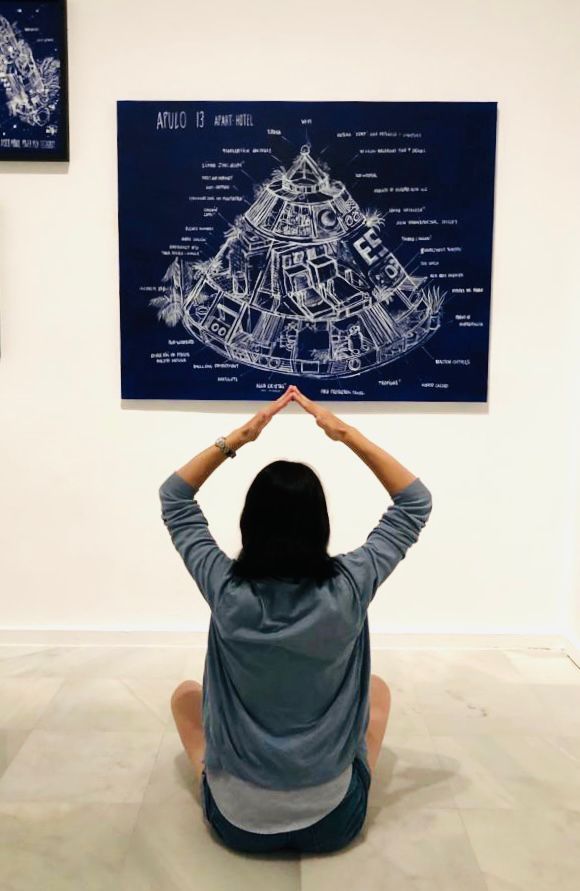
Aligned with this theoretical framework, Machinations explored different forms of resistance, coalition, and creativity that manifest in the present through nearly fifty artists, most from the Mediterranean region and the African continent. Their works reflect on the historical and contemporary circumstances of these territories. The exhibition included a wide range of formats and techniques, such as drawing, painting, comics, sculpture, theatre, dance, performance, installation, film, video, and animation, all approached from a critical perspective.
If you have read my previous post, you will know that I am interested in postmodernism from the perspective of irreverence and skepticism toward the “grand narratives” of modernism. Both post-structuralism and postmodernism focus on questions of representation and examine how dominant frameworks in world politics produce and reproduce power relations: legitimizing certain forms of action while marginalizing other ways of being.
I consider this exhibition an excellent example within a field of research that still has much to contribute to the arts and many other disciplines. I look forward to seeing future exhibitions that continue to explore this terrain.


Sources: Reina Sofia website and Wikipedia.
Leave a Reply