
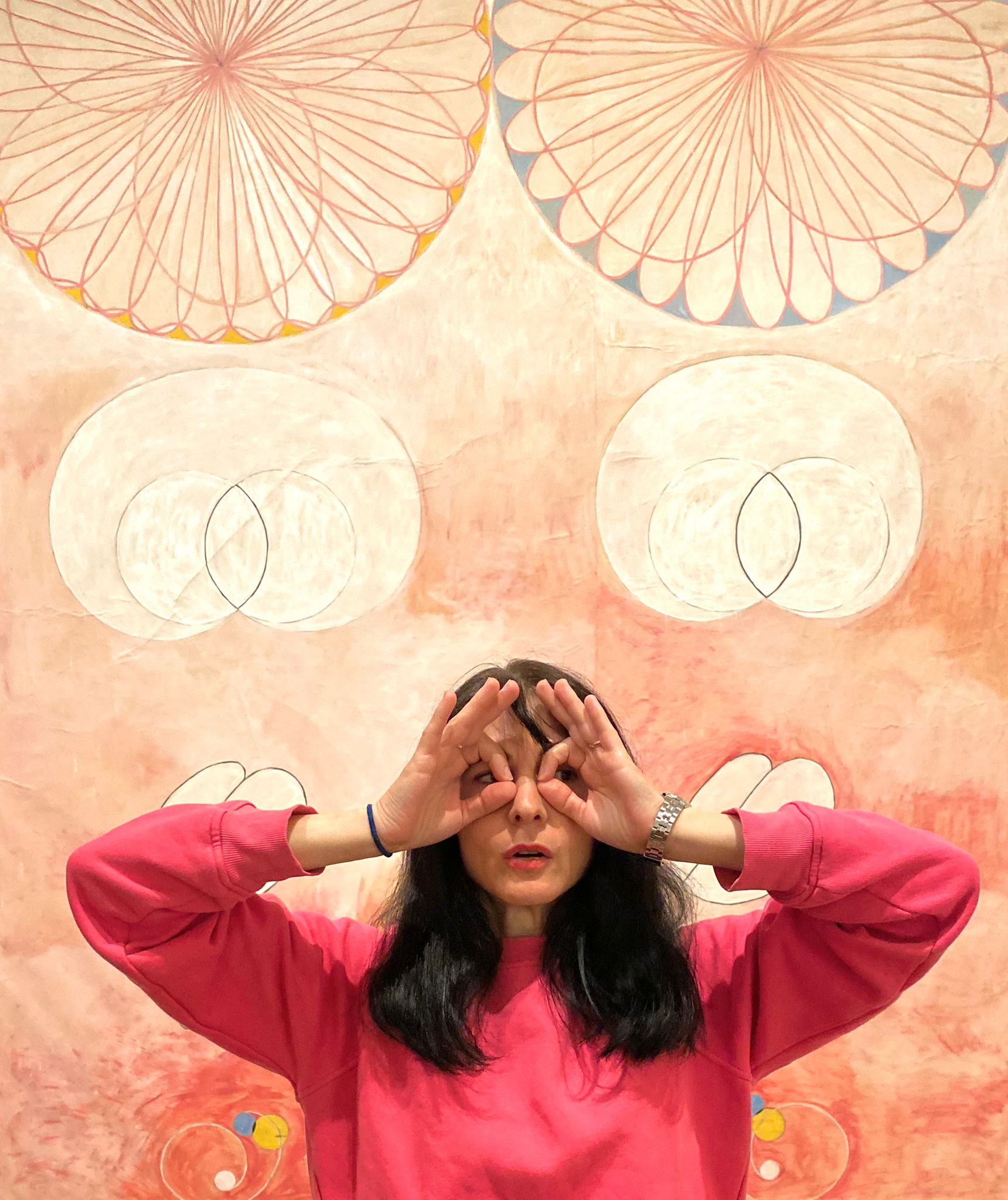
Hilma af Klint & Piet Mondrian: Forms of Life
Tate Modern, London, UK
20 April – 3 September 2023
The most recent exhibition I visited at Tate Modern was Hilma af Klint & Piet Mondrian: Forms of Life. Although the Swedish and Dutch artists never met in person, this exhibition brings them together to explore the development of their nature-inspired abstract practices.
Despite their shared interest in spirituality and abstraction, the artistic evolution of af Klint and Mondrian followed markedly different paths. Nevertheless, this exhibition offered me my first encounter with af Klint’s work, and I was delighted to see a substantial selection of paintings by both artists presented side by side.
Hilma af Klint (1862–1944) was a Swedish artist and mystic whose paintings are now considered among the earliest examples of abstract art in Western art history. She was a member of a group known as The Five, a circle of women inspired by Theosophy who sought to communicate with so-called “higher masters” through séances.
Upon her death, af Klint stipulated that her work should not be shown publicly for at least twenty years, believing that future audiences would be more receptive to her esoteric imagery. History proved her right: more than seven decades later, the Guggenheim’s 2018 retrospective became the most visited exhibition in the museum’s history.
Piet Mondrian (1872–1944) was a Dutch painter and art theorist, widely regarded as one of the most influential artists of the twentieth century. He is renowned as a pioneer of modern abstract art, having gradually shifted from figurative painting toward an increasingly reductive abstract language, ultimately distilled into simple geometric forms. Mondrian’s work was deeply utopian, driven by a search for universal values and aesthetic harmony.
He co-founded the De Stijl movement alongside Theo van Doesburg and developed a non-representational approach he termed Neoplasticism: a “pure plastic art” that he believed essential to the creation of universal beauty.
From the outset of the exhibition, the dialogue between the two artists feels intuitive, as both initially approached abstraction through close observation of nature. Their juxtaposition is not competitive; instead, their works are thoughtfully distributed across separate walls. Af Klint’s botanical studies are grouped together, revealing their delicacy and abundance of detail, while Mondrian’s repeated depictions of the same apple tree demonstrate an almost Japanese sense of devotion and discipline.
Interestingly, Mondrian’s later embrace of primary colours and black lines—so closely associated with De Stijl—is only minimally represented. This restraint mirrors the exhibition’s emphasis on his transitional phases, shaped by his encounters with the diverse artistic movements he experienced in Paris, which ultimately led him to his highly personal and iconic visual language.
The exhibition proves particularly revelatory in its presentation of Hilma af Klint. Largely unknown to her contemporaries, she is frequently compared to twenty-first-century artists due to her radical stance: she was a lesbian, a feminist, anti-establishment, and actively involved in women’s cooperatives.
Here, the exhibition appears to stage a confrontation between a modernist and a postmodern sensibility. Although both artists lived during nearly the same period—Mondrian was born ten years later—and both died in the same year, their artistic philosophies diverge sharply. Mondrian, like many modernists, pursued simplicity, balance, and elegance in colour, shape, and form, in service of utopian ideals. By contrast, af Klint used art as a vehicle for spiritual experience, expressing a deeply personal and intuitive cosmology.
Modern art has traditionally been associated with male artists, whereas postmodern art embraces contributions across genders, ethnicities, and social classes. Twentieth-century modernist abstraction sought meaning in colour, logic in line, and internal coherence, striving toward an idealised notion of artistic beauty. Postmodern art, by contrast, rejects the idea of a single correct way of making art, favouring complexity, ornamentation, and chance.
In conclusion, Forms of Life offers a compelling comparison between two fundamentally different ways of understanding and creating art, both closely tied to the evolution of abstraction in the last century. Yet their artistic journeys—from nature to abstraction—remain strikingly distant from one another.
Through Hilma af Klint, we witness an artist exploring belief systems through visionary practice, channelling spiritual messages into exuberant and decorative works that have only recently begun to be fully recognised and understood. Through Piet Mondrian, we trace the evolution of modern art in the first half of the twentieth century: a process shaped by intellectual inquiry, cultural exchange, and formal reduction, culminating in a body of work that continues to inspire generations of artists today.


Mondrian


Sources: Tate website, The Guardian, Wikipedia.
Leave a Reply