
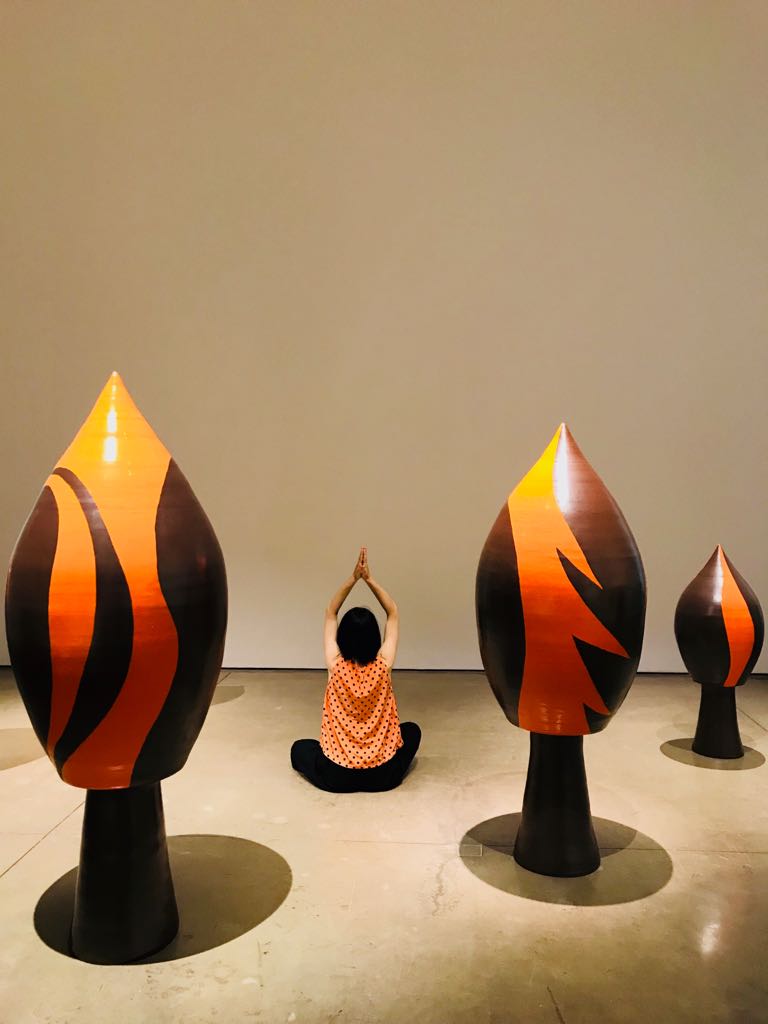
Seung-taek Lee
White Cube – Mason’s Yard, London, UK.
25 May 2018 – 30 June 2018
The Art Blackberry and I visited the White Cube at Mason’s Yard in London last week and discovered the work of Seung-taek Lee, a Korean interdisciplinary artist best known for conceptualizing the notion of “anti-concept” or “anti-art.” Trained as a sculptor, he has also worked as a performance artist and is one of the first-generation pioneers of experimental art in South Korea.
Since the beginning of his career in the late 1950s, Lee worked independently from the dominant art scene in South Korea, while most artists and art critics followed Western art trends as the only path to recognition. He argued that these artists were unaware of their own identity and began experimenting to understand the true nature of Korean modern art. That said, his artworks from the 1960s and 1970s have been associated with movements such as Land Art, Arte Povera, and Post-Minimalism.
This exhibition at the White Cube Mason’s Yard gallery in London is Lee’s first solo show in the UK. It comprises artworks from the 1960s to the present day and reveals his enduring interest in materiality and cultural identity.
A defining characteristic of his practice is the binding of found objects, natural materials, or existing architectural structures to suggest the transformability of their inherent material properties. This approach is evident in works that appear completely different from one another. Indeed, the exhibition spreads across two floors, and at first glance, the artworks on the ground level seem to be by a different artist than those in the basement.
As Lee has declared at some point, the work’s visual impact comes from the “tension between the wooden bar, precariously hung from two thin cords, and the clusters of bifurcated stones that effectively conjure a sense of gravitational pressure”.
On the ground floor, the works appear organic and closely connected to nature. Various sculptures are made of granite, a material widely used in Korea for outdoor monuments due to its durability. Lee’s artworks here appear soft and even sensual. Some are placed directly on the floor without a plinth, creating a more immediate and accessible experience. In two works, he ties small pieces of granite with rope or wire, challenging the viewer’s perception of weight and stability.
As Lee has stated, the visual impact of his work comes from the “tension between the wooden bar, precariously hung from two thin cords, and the clusters of bifurcated stones that effectively conjure a sense of gravitational pressure.”
The Art Raspberry’s photograph of one of these works, with the model immediately below the stones, accentuates this feeling of threat from the stones and the vulnerability of the model.
On this level, we also saw framed works made of ropes on canvas, referred to as “canvas drawings.” The artist uses rope as an alternative to the traditional line, with knots and loose ends giving the works a more tactile and three-dimensional quality.
In the basement, monumental vinyl structures from the 1960s were recreated in striking, bright colors. Originally made from cheap, factory-produced vinyl, they have been remade for this exhibition using more durable urethane vinyl with a similar appearance. These works clearly contrast with the neutral, organic palette of the ground-floor gallery. Nevertheless, the themes of enveloping and binding remain central to Lee’s practice here. I particularly enjoyed interacting with the large vinyl structures—the quiet, dimly lit space encouraged mindfulness and contemplation.
The “binding” of objects is both an artistic strategy and a symbolic gesture of subversion used by Lee. It not only destabilizes the viewer’s perception but also questions the existing form and intended function of the objects.


Leave a Reply