
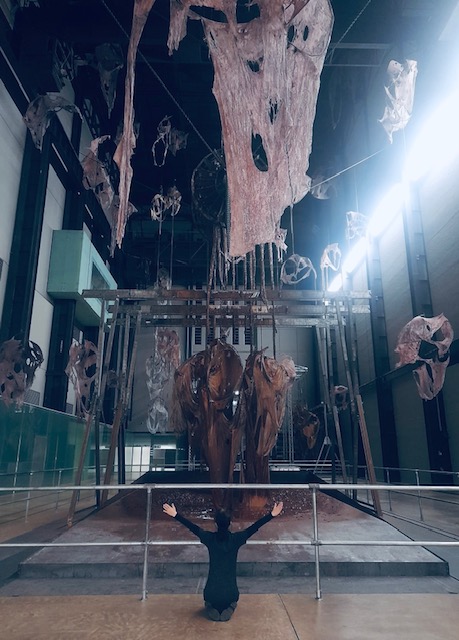
Mire Lee: Open Wound
Tate Modern, London, UK
9 October 2024 – 16 March 2025
The latest installation at Tate Modern’s Turbine Hall is one of the most striking and moving works I’ve seen in years. Created by South Korean artist Mire Lee, Open Wound reawakens the building’s industrial past while exploring how post-industrial landscapes shape the human body and psyche.
Lee reimagines the Turbine Hall as the interior of a body, transforming it into an unsettling space where machinery and flesh-like materials blend into a surreal, grotesque factory. Drawing on her fascination with rigid mechanical systems and organic, malleable forms, she creates a world that speaks to themes of precarity, decay, and renewal.
Lee populates the Hall with skins—fabric sculptures suspended from the ceiling by metal chains. At the centre of the Hall’s east end, a motorized turbine, suspended from a ceiling crane, slowly spins. It releases a viscous liquid from flesh-like silicone tentacles into a large tray. As the factory operates, new skins are soaked beneath the turbine, then moved by technicians to harden on nearby racks before being lifted into the air. Over time, they accumulate —birthed from the building’s body while seemingly shedding from the ceiling above. This ongoing process of production and decay unfolds, facilitated by both machinery and human hands.
The drying of the fabric skins recalls processes used in textile manufacturing. Their chain suspensions are inspired by pit-head baths—early group washing facilities used by coal miners. In these spaces, a pulley system allowed miners to hang their street or work clothes from the bathhouse ceiling while they laboured in the mines or rested at home.
Lee explores the tension between soft organic forms and rigid mechanical systems through her materials. Her kinetic sculptures resemble organisms and machines turned inside out, exposing their inner workings to unsettling effect. Lee’s turbine appears as ‘an open wound that never closes.’
The result is deeply visceral. The installation provokes a complex mix of emotions —tenderness, empathy, unease, and even disgust. The fragile skins suggest vulnerability, care, and the formation of new identities. I found the work incredibly effective in generating an emotional response, making the viewer acutely aware of their own physical presence within the space.
Born in South Korea in 1988, Lee lives and works between Amsterdam and Seoul. She is interested in the power of sculpture to affect both the viewer and the surrounding space and is unafraid to push artistic boundaries in spectacular ways. Her immersive and thought-provoking installations engage the senses and create spaces to reflect on emotion, precarity, and human desire.
For me, what lingers most is the installation’s ability to capture the vulnerability of our existence in a world full of uncertainty. The slow, relentless movement of the machinery creates an eerie sense of being part of a system beyond our control, making human connection and care feel even more essential.
Open Wound is a deeply affecting work that stays with you long after you leave the Turbine Hall. If you’re in London, I highly recommend experiencing it for yourself before 16 March.
Entrance: Free.
Special thanks to photographer Ottavia Castellina for collaborating on these images.


Leave a Reply