
Joan Jonas
Tate Modern, London, UK
14 March – 5 August 2018
Tate Modern’s new exhibition dedicated to Joan Jonas offers a compelling overview of an artist who has fundamentally reshaped the language of performance, video and installation since the late 1960s. Bringing together more than five decades of work, the show highlights Jonas’s enduring influence and her ability to merge storytelling, movement and image into a singular visual world.
Born in New York in 1936, Jonas initially trained in Art History before turning to sculpture. Immersed in the vibrant downtown scene of the 1960s, she soon gravitated towards performance and video, shaped by her time studying with choreographer Trisha Brown and collaborating with Yvonne Rainer and Steve Paxton. Tate Modern’s exhibition, curated by Andrea Lissoni in close collaboration with the artist, clearly traces how these early influences opened the path to a radically experimental practice.
Organised by themes, the exhibition reveals Jonas’s recurring interest in myth, folklore, literature and cross-cultural narratives. Her use of props, mirrors and layered video imagery reflects a deep engagement with music, female identity, the natural world and the shifting relationship between bodies and space. The opening gallery, featuring objects from Jonas’s personal collections — masks, wooden animals, travel souvenirs — is accompanied by a caption that reads: “One object next to another is like making a visual poem.” This sentiment becomes a quiet key to the entire exhibition. It felt like stepping into the artist’s inner landscape, one that is intuitive, symbolic and insistently personal.
A room dedicated to her early performances highlights Jonas’s collaborative spirit. Archival material created with artists such as Benjamin Blackwell, Babette Mangolte, Richard Landry, and others provides insight into seminal works like Mirror Pieces (1968–71), which plays with audience perception through reflective surfaces, and Organic Honey Visual Telepathy (1972), where Jonas multiplies and distorts her own image on screen. These early experiments established many of the strategies she would refine over the following decades.
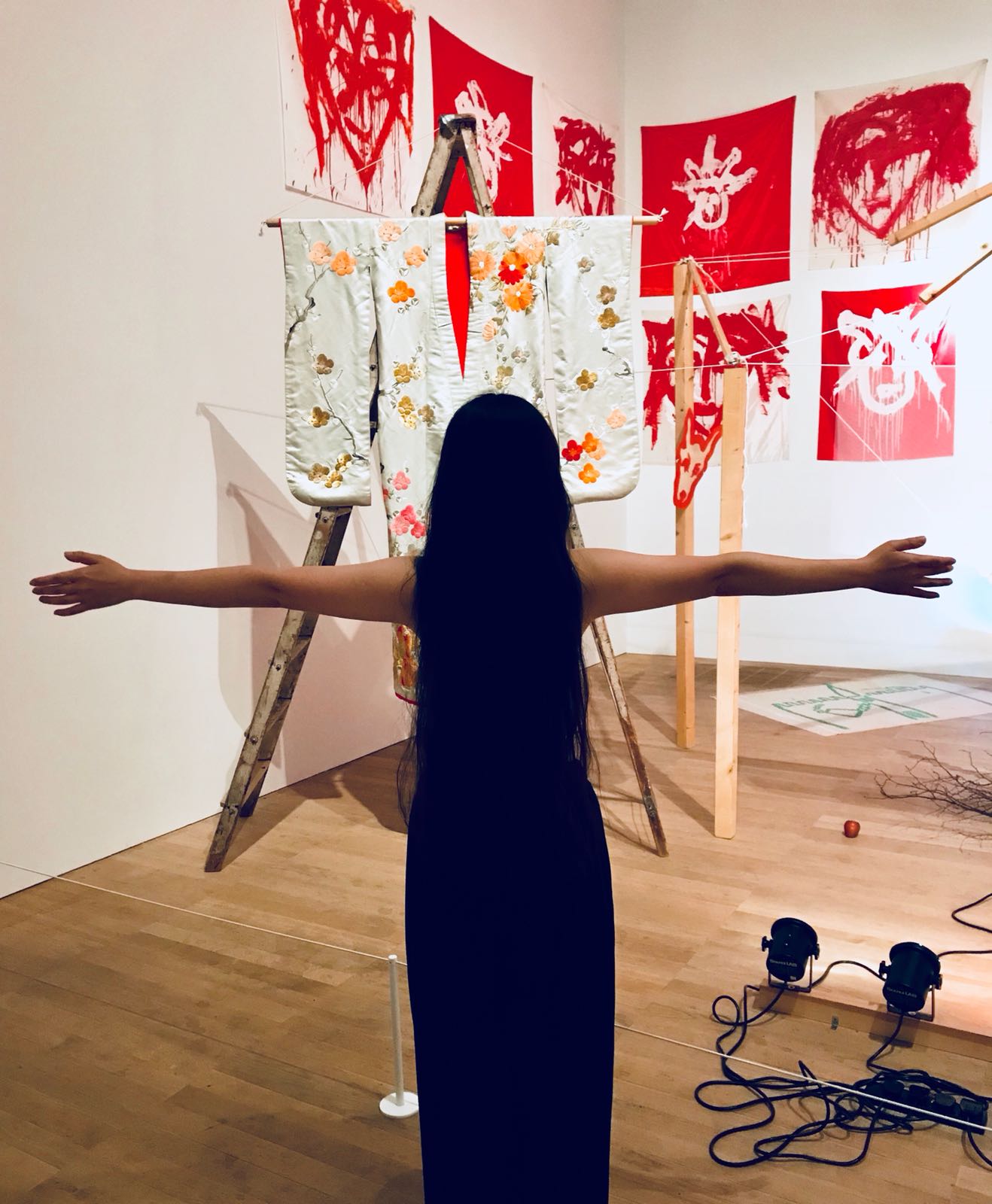
One of the most striking installations is The Juniper Tree (1994), developed from performances in the late 1970s and based on a Brothers Grimm tale of violence, transformation and rebirth. Jonas revisits this dark narrative with a poetic yet unsettling visual vocabulary. Standing before the installation, I found myself drawn not only to the imagery but to the emotional logic of the story — a reminder of Jonas’s talent for transforming familiar tales into layered meditations on identity and memory. The Art Blackberry, performing intuitively beside the installation, offered an interpretation that imagined herself as the juniper tree: silent, watchful, and unexpectedly protective. It added a thoughtful and intimate dimension to the work.
Jonas’s fascination with myth continues in Lines in the Sand (2002), created for Documenta 11, where she reimagines the myth of Helen of Troy to comment on contemporary political narratives. Near the end of the exhibition, Double Lunar Rabbits (2010) blends Japanese and Aztec lunar myths into a dreamlike choreography of images and drawings, showing Jonas’s ability to bind far-reaching cultural motifs into a coherent, timeless language.
A particularly memorable room gathers works centred on birds, appearing as video projections, suspended forms, and painted figures. It is a space of movement, fragility and imagination. It reminded me of childhood dreams of flying — a moment where the exhibition’s intellectual and emotional registers briefly converge.
The final galleries, dimly lit and ritualistic in tone, present Jonas’s most recent works, which address climate change and the vulnerability of non-human life. These installations underscore how her longstanding concerns with ecology and embodiment now take on sharper urgency.
Tate Modern’s retrospective makes clear that Jonas has never stopped experimenting — or storytelling. The exhibition not only honours an influential career but also invites viewers into a universe where myth, memory and image continue to shift, evolve and resonate.
You can see below The Art Berries performing next to Joan Jonas’s artworks.


Leave a Reply