
Magdalena Abakanowicz: Every tangle of threat and rope
17 Nov 2022 – 21 May 2023
Tate Modern, London, UK
Magdalena Abakanowicz’s exhibition at Tate Modern has been the most compelling I have seen this year, offering an exceptional encounter with the depth and originality of her practice.
Magdalena Abakanowicz (1930–2017) was a pioneering Polish sculptor and fibre artist renowned for her radical use of textiles as a sculptural medium. Today, she is regarded as one of Poland’s most internationally celebrated artists. Born into an aristocratic family, she spent her early childhood in the countryside before the Second World War and the subsequent communist regime transformed her family’s circumstances.
Her early work drew inspiration from the neutral landscape of the forest she grew up in, which afforded her slightly less censorship than many of her contemporaries. Even so, one of her first exhibitions was shut down by the authorities for failing to promote socialist ideals. Individual expression was expected to serve the collective good. At the same time, the state encouraged collaboration between designers, craftspeople and artisans—a dynamic Abakanowicz used to her advantage. By the 1960s, she had become a pioneer of fibre-based sculpture and installation.
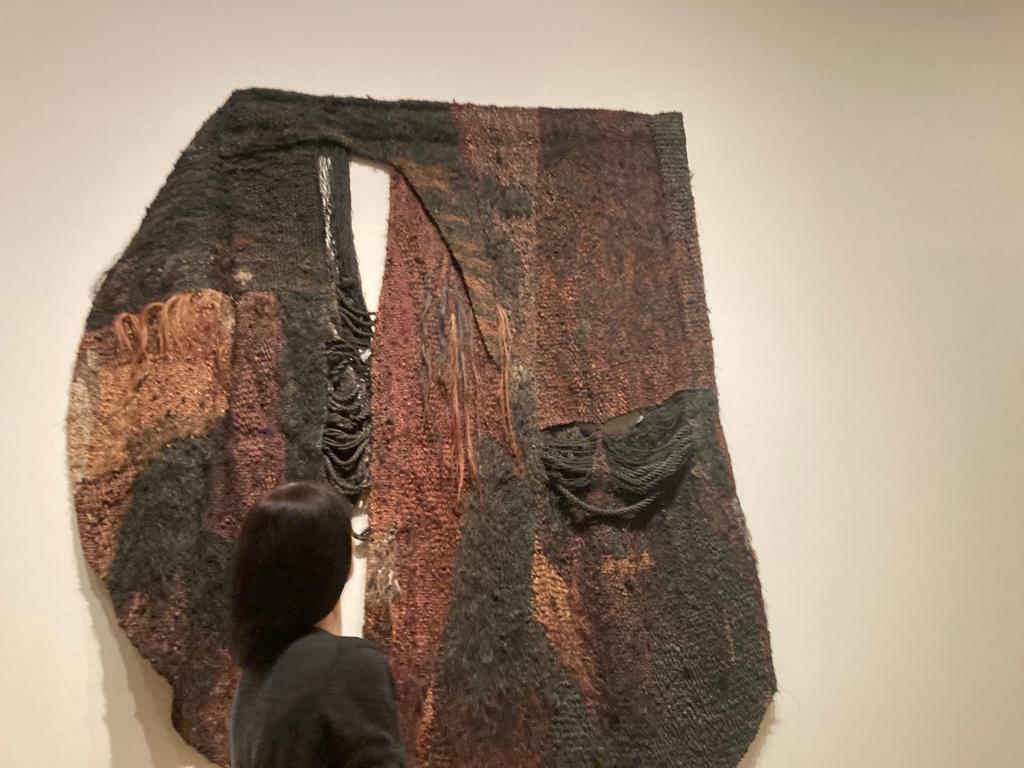
Abakanowicz was, in essence, a weaver of sculptures. What she achieved was so radical that it continues to astonish today. She took the flat, conventional tapestry—a form woven for millennia—and transformed it into monumental three-dimensional structures. Suspended from the ceiling, her woven forms possess an organic presence that envelops the viewer, articulating her reflections on the power of nature and humanity’s place within it.
The exhibition begins with smaller works that trace the artist’s early development: naturalistic abstraction, geometric compositions filled with organic shapes, works on paper and canvas. Her early tapestries—large, sombre abstractions in brown, beige and tan wool—resemble worn and weathered carpets, with frayed edges and braided sections.
Abakanowicz once described fibre as “the basic element constructing the organic world… the tissue of plants, leaves and ourselves, our nerves, our genetic codes… We are fibrous structures.”
Gradually, she abandoned the rectangular tapestry format, allowing her woven works to expand freely into space. Curved, perforated, undulating forms began to hang from the ceiling—fibrous, twisted, knotted, accompanied by trailing ropes or even animal horns, as though the works possessed a life force of their own. Their material warmth and earthy scent create a deeply tactile, immersive experience.
The central gallery presents a powerful grouping of these dark, fibrous forms. Encountering them feels like stepping into a primordial landscape—raw, protective, elemental. As the exhibition progresses, the human body begins to emerge in fragmented form. One encounters depictions of the female body, opened labia, bodily orifices and protrusions, breasts, pregnant bellies: corporeality rendered as matter, fibre and texture.
Throughout the 1960s and 70s, critics struggled to categorise Abakanowicz’s multiform practice. Were these works sculpture, fibre art, applied art? Her suspended weavings were variously described as “carpet creatures,” and she was called “a painter at the loom.” Ultimately, they became known simply as Abakans, a term derived from her name and now synonymous with her revolutionary approach.
The Tate Modern exhibition feels almost primal. As you move through the galleries, a forest appears to gather around you. Some works branch like trees, others twist like vines, others resemble hollow trunks offering shelter from an oncoming storm. This ancient, mysterious forest—entirely made of wool—gives way to a deconstructed human body, reminding us, unmistakably, that we are part of nature. We would do well not to forget that.


Leave a Reply