
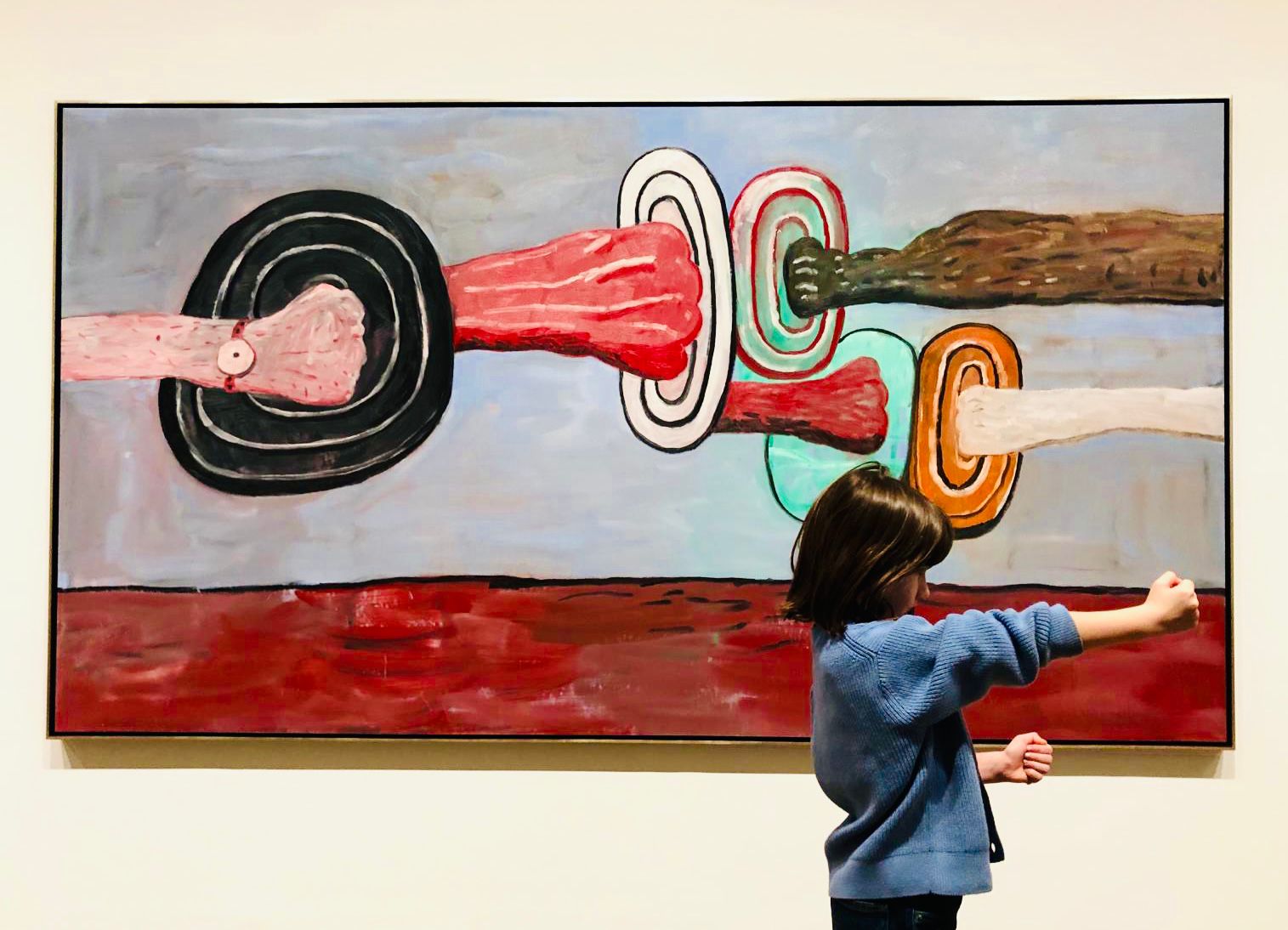
Philip Guston
Tate Modern, London, UK
5 October 2023– 25 February 2024
This art exhibition, which we visited at Tate Modern last month, introduced me to an artist I had only briefly known. It marked the first major retrospective of this artist in the UK in nearly 20 years.
Philip Guston, born in Canada to a Jewish immigrant family initially named Goldstein, grew up in the US. As a Canadian American artist, he employed various mediums, including painting, printmaking, mural, and drawing, earning recognition as one of the most influential American painters of the last century.
His early work comprised murals in the Mexican muralism style, collaborating with the renowned Mexican muralist David Alfaro Siqueiros, and paintings, reminiscent of Picasso’s blue period, that addressed wars abroad and racism in America, drawing inspiration from consistent interests and concerns.
Guston achieved acclaim as one of the celebrated abstract painters of the 1950s and 1960s, standing alongside Mark Rothko and childhood friend Jackson Pollock. However, amid the social upheavals of the late 1960s, he criticized abstraction and shifted to large-scale paintings featuring comic-like figures, some adorned with white hoods as a representation of evil and the perpetrators of racism. This shift showcased his distinctive voice, establishing him as one of the most influential painters of the late 20th century.
For over 50 years, Guston created paintings and drawings capturing the turbulent world he witnessed. The traveling retrospective, co-organized by four museums, including Tate Modern, postponed its schedule for four years in 2020, citing that Guston’s work couldn’t be shown “until a time when the powerful message of social and racial justice can be more clearly interpreted.” The art world’s reaction, protesting with allegations like “How dare you postpone this show; everyone knows these paintings are against racism,” highlighted the controversial nature of Guston’s works.
While Guston’s art didn’t particularly resonate with me due to its obsessive focus on the surrounding evil, I appreciate that this exhibition introduced me to a very idiosyncratic artist. He developed his style alongside the major art movements of the past century, finding his voice as an activist-artist using his work as a tool to bring attention to crucial social issues. In today’s tumultuous times, marked by ongoing wars in Ukraine and the Middle East, Guston’s work remains relevant, reflecting the challenging realities of our era.


Leave a Reply