
Rayyane Tabet: Encounters
Parasol Unit foundation for contemporary art, London, UK
24 September – 14 December 2019
The current show of Rayyane Tabet at Parasol Unit is by Beirut-born and based artist Rayyane Tabet. He presents eight works spanning the past thirteen years, installed together for the first time. I wasn’t familiar with Tabet’s work before, but I was pleasantly surprised. The minimalist quality of his pieces is intertwined with historical and cultural references to Lebanon, often combined with personal narratives.
Tabet seems interested in presenting an alternative perspective on the political and economic events that have shaped his country in recent decades. Through his work, he seeks to contribute to the outside world’s understanding of this complex place.
This approach makes it easier for visitors to connect with his work. Tabet draws inspiration from overlooked objects, wrapping them in personal anecdotes and transnational histories. According to the artist, how Lebanon is perceived—both externally and internally—is rarely unified. Children in different communities are taught different versions of history.
“I’m interested in the question of whether we could create a history told by objects and materials. A lot of the time those last longer than people and are able to overcome moments of violence and marginalisation in a way that people cannot,” Tabet says.
On the ground floor, at the back of the gallery, we found a large red star hanging from the ceiling, accompanied by a red horse and other objects. We were drawn to the star for its playful, interactive quality. (See some photos below.)
Another poignant work features a pair of rowing oars. Tabet’s father had once planned to use the boat they belonged to in an attempt to flee Lebanon for Cyprus—a plan that was ultimately aborted. Years later, the family stumbled upon the same boat by chance. Tabet purchased it and incorporated it into his practice, giving the object a new life and narrative.
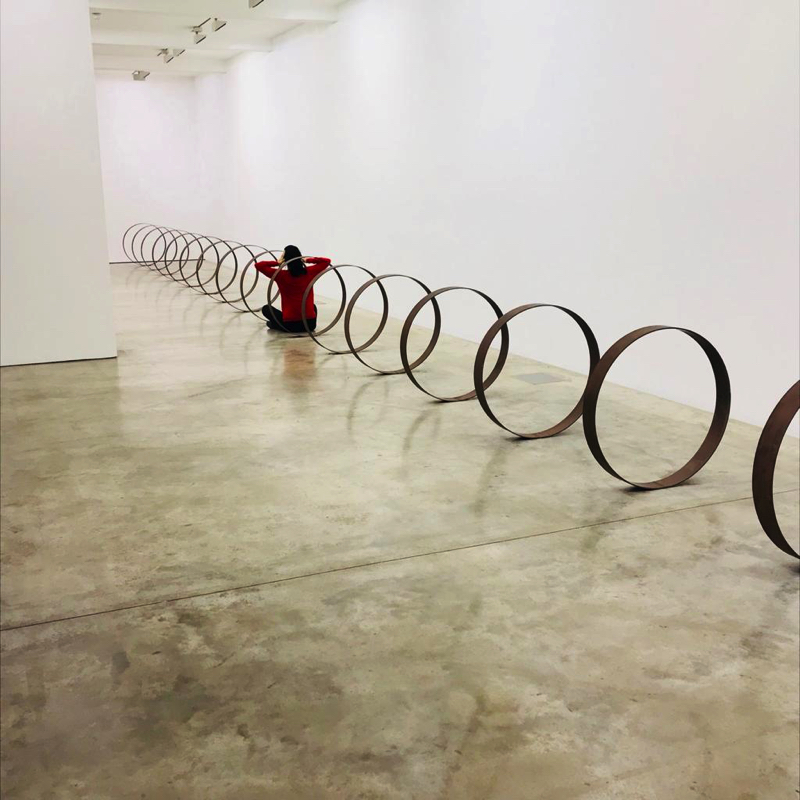
Our favourite piece in the exhibition, however, was Steel Rings (2013–), a sequence of 28 rolled-steel rings arranged in a line. At first glance, the work’s minimalist simplicity invites quiet contemplation and interaction. But upon closer inspection, its layers of meaning emerge. Each ring is engraved with a distance and a set of coordinates, marking a specific location along the now-defunct Trans-Arabian Pipeline (TAPline). Built in 1947 by a consortium of U.S. oil companies, once the world’s largest long-distance oil pipeline, it remains the only physical structure crossing the borders of Saudi Arabia, Jordan, Syria, the Golan Heights, and Lebanon. When the American TAPline company finally abandoned it after decades of regional conflict, the pipeline was left in situ.
These rings stand as witnesses to a turbulent period in history. TAPline did not survive the first Gulf War (1990–91), abandoned in part due to Saudi Arabia’s opposition to Jordan’s support of Iraq. Though largely untold, this story lingers in popular memory, and Tabet raises it elegantly and subtly within the gallery space.


Leave a Reply