
Jason Wilsher-Mills: Jason and the Adventure of 254
Wellcome Collection, London, UK
21 March 2024 – 12 January 2025
The art exhibition, Jason and the Adventure of 254 by artist Jason Wilsher-Mills, is now showing at the Wellcome Collection. I was deeply moved when I saw this whimsical exhibition, and I want to share it with you here.
The show is inspired by the artist’s experience of becoming disabled as a child. Wilsher-Mills transports viewers to Pinderfields Hospital in Wakefield on 1 August 1980, at precisely 2:54 pm. This was the pivotal moment when he and his parents learned of the autoimmune condition that left him paralyzed from the neck down from age 11 to 16. Remarkably, this was also the exact moment that Sebastian Coe won the 1500-metre race at the Moscow Olympics, wearing the number 254—a race broadcast on the ward’s TV. Wilsher-Mills sees this serendipitous coincidence as the spark for his artistic career.
The artist intertwines these two life-changing events in a profoundly inspiring way. Rather than focusing on the trauma of his illness, he sees that moment as the beginning of his creative life. His vibrant installation invites you to explore his memories and reflect on how disability and adversity can serve as a catalyst for creativity and self-discovery.
The exhibition delves into what was happening in his body, his imagination, and the world around him. It explores themes of childhood, family, memory, and the nature of creativity—how it works and where it comes from. The artist drew inspiration from 1980s television and anatomical drawings at the Wellcome Collection, which triggered memories of his hospitalization.
The installations, bursting with bright and engaging colours, are based on hundreds of preparatory drawings he created for the show. These works can also be explored in an adjacent room. The centrepiece sculpture, Figure in a Bed, portrays the artist in bed watching TV. A figure that has a TV for a head representing the athlete Sebastian Coe. Surrounding Wilsher-Mills are green toy soldiers symbolizing his white blood cells, which, as doctors explained, were attacking his own body instead of defending it.
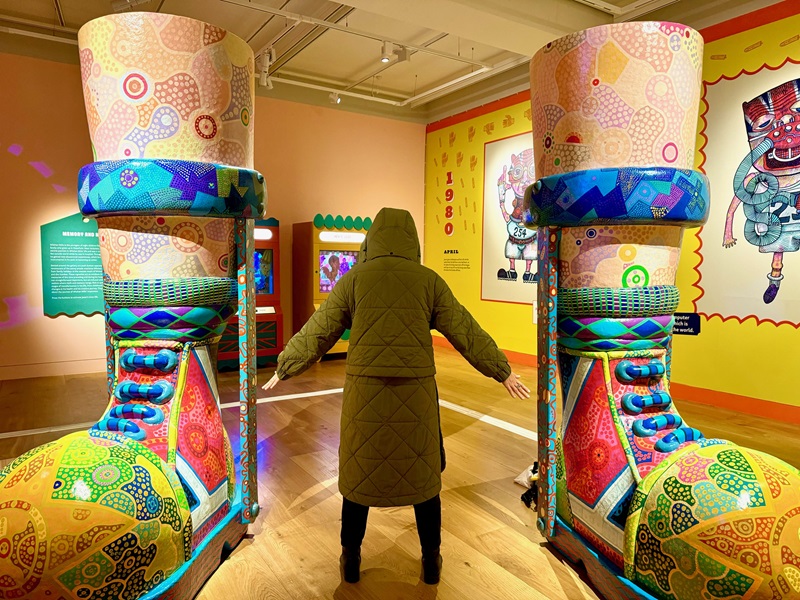
Another striking installation is Calliper Boots, which I personally engaged with during my visit. This piece represents the medical boots he was given to support his weight and train his ankles—a painful and unwelcome experience. In a creative twist, Wilsher-Mills reimagined these boots as vibrant, brightly painted Dr. Martens, the type of footwear he would have loved as a child.
“My work deals primarily with my self-image as a disabled person, and the long-standing effects of illness and disability. I do this through the use of theatrical trickery, humour, and honesty. I can place myself in environments and creative narratives that describe what it is to me to be disabled. I understand that through art I can free myself from the restrictions that my body presents to me.”
—Jason Wilsher-Mills, Disability Horizons
The exhibition also features interactive, push-button-operated dioramas reminiscent of the penny arcade machines Wilsher-Mills saw as a child at seaside resorts. These magical dioramas provide windows into his childhood memories, blending myth and reality in a dreamlike manner. They portray key stages of transformation in his life and offer insight into his sources of inspiration.
In addition to the dioramas, drawings by Wilsher-Mills are displayed on the gallery walls, enriching the experience further.
Overall, the exhibition is a deeply uplifting portrayal of how Wilsher-Mills’ disability shaped his identity and ignited his passion for art. I found his approach profoundly hopeful, showing how negative experiences can become opportunities for growth and learning. His work encourages us to reflect on the resilience of the human spirit and how perspective can turn adversity into a source of strength.


Entrance to the exhibition: Free.
Leave a Reply