
Christo: Air
Gagosian Gallery, Grosvenor Hill, London, UK
21 May – 21 August 2026
What is it about wrapping objects that immediately makes them feel significant? In cultures like Japan, wrapping is a deeply rooted tradition that signifies care, respect and beauty of form. At Gagosian Gallery, Christo: Air explores exactly that question, using wrapping not simply to conceal objects, but to give physical presence to the intangible.
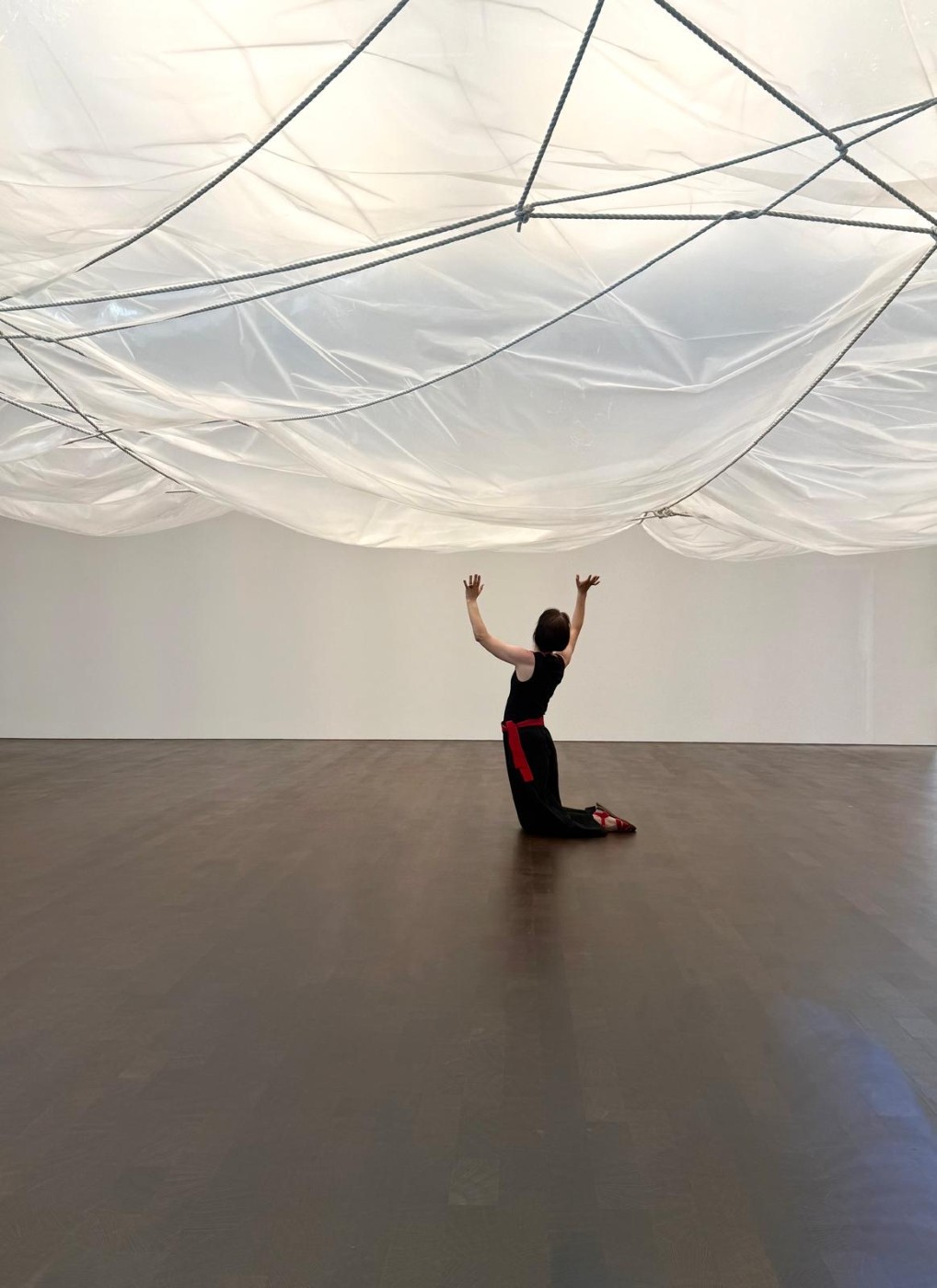
Christo wanted to contain the air within a room, but the original idea was limited by technical constraints. Fifty years after it was first proposed for the Institute of Contemporary Art in Philadelphia, the work has finally been realised, posthumously fulfilling a vision shared by Jeanne-Claude, who died in 2009, and Christo, who died in 2020. The opening gallery has been split horizontally by a huge polyethylene sack, held against the ceiling by white ropes.
Christo and Jeanne-Claude are best known for their monumental environmental interventions and are widely regarded as pioneers of ephemeral art, creating temporary installations that transformed buildings, landscapes and public spaces before disappearing. Although these ambitious public works made them internationally recognised, they originated in much smaller studio experiments like those on display here.
In the 1960s, Christo began sealing air inside clear polyethylene packages bound with rope. This forced the eye to treat transparent space as a solid, physical mass. Air Package on a Ceiling functions like an internal cloud filling the room. Suspended just above head height, visitors must crouch beneath it. The space remains empty, yet the intervention gives it an unexpected sense of weight. Christo succeeds in making the uncontainable briefly appear containable.


You might wonder why an exhibition devoted to Christo and Jeanne-Claude focuses on relatively modest indoor works when they became famous for wrapping landmarks and landscapes. That was certainly my first question. The answer becomes clear as the exhibition unfolds. Rather than existing separately from the monumental projects, these intimate works function as their conceptual laboratories, testing ideas later realised on an environmental scale.
Rather than illustrating an idea, the works ask visitors to experience perception itself, echoing philosopher Maurice Merleau-Ponty, who argued that meaning emerges first through bodily encounter before intellectual analysis.
One of the exhibition’s greatest pleasures is seeing Christo’s remarkable preparatory drawings. They were not artistic sketches, but precise proposals combining architecture, engineering and visual imagination. More importantly, they funded every project. Refusing sponsorship, grants or corporate backing, Christo and Jeanne-Claude financed their ambitious interventions by selling these original drawings, collages and studies.
Photographs displayed in a vitrine document an ambitious work created for Documenta in 1968: a giant polyethylene tube that initially refused to stand upright. Images show it collapsing awkwardly until assistance from the US Air Force finally brought it into position. The sequence reveals the logistical challenges behind works that often appear effortless.


That engineering became even more critical in later projects. When wrapping historic landmarks such as the Wrapped Reichstag or L’Arc de Triomphe, Christo designed sophisticated support structures that protected the historic fabric beneath the enormous quantities of fabric. The Wrapped Reichstag alone required twenty-four years of negotiations across six German presidencies, only to exist for just two weeks.
That extraordinary imbalance between preparation and duration lies at the heart of Christo and Jeanne-Claude’s practice. Their projects demanded decades of planning and millions of pounds, yet the artworks themselves survived only for days or weeks before disappearing. In that sense, they stand among the most celebrated examples of ephemeral art. It was precisely this impermanence that interested them. Because the installations could not be owned, preserved or permanently controlled, they existed only through direct experience and memory. Once dismantled, only photographs, films and preparatory studies remained.
The exhibition also includes wrapped books, telephones and Wrapped Automobile. Concealing these familiar objects removes their practical function and encourages viewers to focus instead on their volume, contours and textures. Stripped of their utility, they become sculptural forms rather than everyday possessions.
The final gallery brings this idea to a more personal scale with a wrapped Volvo once owned by Serge de Bloe, Christo’s art dealer. Unable to part with the ageing car, he asked Christo to intervene. Rather than allowing it to end its life in a scrapyard, the artist transformed it into a work of art, preserving it as a monument to its own history.


What first appears to be a simple act of concealment becomes an invitation to reconsider how we perceive space, objects and even absence itself. By hiding rather than revealing, Christo shows that concealment can sometimes sharpen perception.
Leave a Reply