
Kemang Wa Lehulere: Not Even the Departed Stay Grounded
Marian Goodman Gallery, London, UK
13 September – 20 October 2018
We visited this exhibition a couple of weeks ago at the Marian Goodman Gallery in London, and I wanted to introduce you to an artist who is rapidly becoming one of South Africa’s most significant contemporary voices.
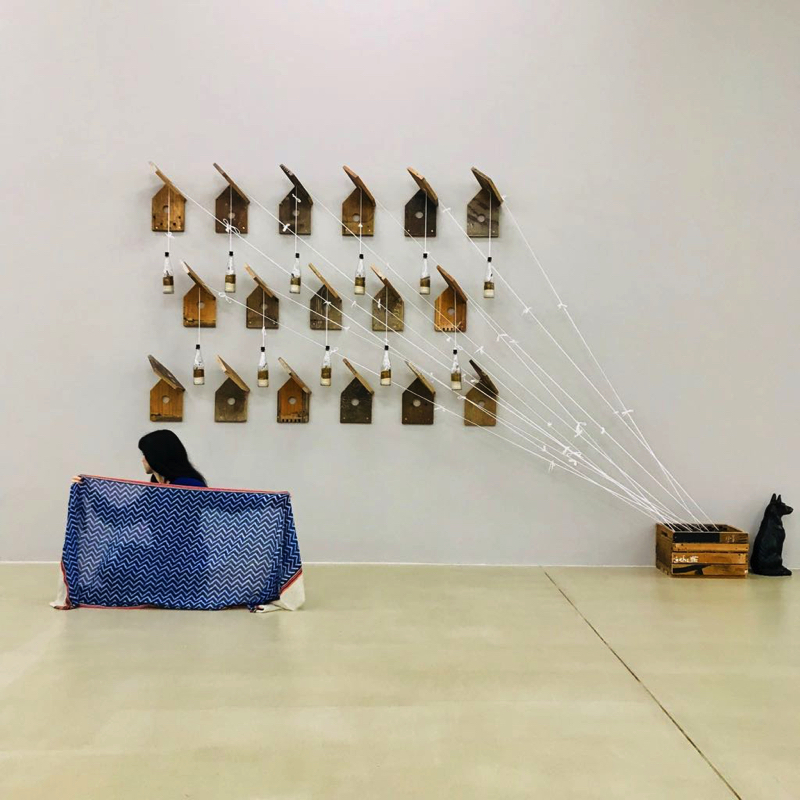
Upon entering the gallery, I encountered a series of installations and wall drawings made with wood, metal, chalk, glass and rope, presented in stark black and white or in their raw material state. The exhibition clearly conveyed a strong social message, yet the artist never sacrificed aesthetic intention. In fact, he uses visual beauty and material refinement to amplify the political resonance—something I particularly value. I appreciate art with a socio-political dimension, especially today, but I am even more drawn to work that manages to be both meaningful and visually compelling.
Kemang Wa Lehulere was born in Cape Town and first rose to prominence in 2006 with Gugulective, a community-engaged collective he co-founded with his childhood artistic collaborator, Unathi Sigenu, in the former township of Gugulethu. At that time, his practice revolved around socially engaged performance, producing pamphlets that challenged local histories or setting up interventionist pirate radio stations. Only after several years of activism did he begin creating sculptural objects and drawings as the residue or extension of these performative actions, eventually pursuing formal art education and graduating in 2011.
Drawing on these formative years, Wa Lehulere’s work channels feelings of post-apartheid unrest and broader socio-political tensions, re-enacting what he refers to as “deleted scenes” from South African history.
Recurring visual elements in his practice include messages in bottles, sphinx-like ceramic dogs, and birdhouses symbolising the forced removals under apartheid. Large chalk-covered blackboards and various objects suspended from shoelaces filled the space. Yet his most striking works remain the reconfigured salvaged school desks—wood and metal structures that reference the 1976 student uprisings and appear throughout the exhibition.
His interest in the Dogon people of Mali and their indigenous astronomical knowledge is also present. Several works alluded to the controversy around the Dogon’s awareness of Sirius B, a dwarf companion star invisible to the naked eye and unknown to Western astronomers until modern instruments. Wa Lehulere used laces to form star constellations, a gesture that points both to the racist disbelief in African scientific knowledge and to the persistent denial of opportunity faced by young Black South Africans today.
This exhibition serves as a powerful reminder that art can articulate our concerns about the world with extraordinary clarity—and that artists like Wa Lehulere are able to do so through a deeply personal visual language that is both thoughtful and aesthetically striking.


Leave a Reply