
Kiki Smith
Timothy Taylor Gallery, London, UK
18 September — 1 November 2025
I’ve recently seen an exhibition at Timothy Taylor Gallery that completely fascinated me. It felt as if I were stepping into a magical realm created by the artist Kiki Smith. The show revolves around Smith’s ongoing engagement with the natural world and its connection to mythology, spirituality, and the human condition. It truly felt like entering her own universe — my favourite kind of exhibition.
Kiki Smith (b. 1954, Nuremberg, Germany) is a German-born American artist whose psychologically charged figurative sculptures and prints have made her a pivotal figure in contemporary art. While her work of the late 1980s and early 1990s addressed subjects such as AIDS, feminism, and gender, her more recent practice explores the relationship between the body and nature. Smith lives and works in New York City and the Hudson Valley.
Upon entering the ground floor of the gallery, I encountered two life-size bronze sculptures, Winter and Capricornus (both 2021), depicting the artist’s zodiac sign, Capricorn. They stand on their hind legs, not touching — perhaps climbing in excitement, or seeking our attention? Smith gives form to this imaginary creature onto which we project ideas of rationality, ambition, and discipline. The gentle oxidation of the bronze lends a bluish tint that, together with the contact prints on the wall, each marked by a single luminous circle, transforms the room into a mysterious, almost mystical scene.


Signal V and Signal II, 2024
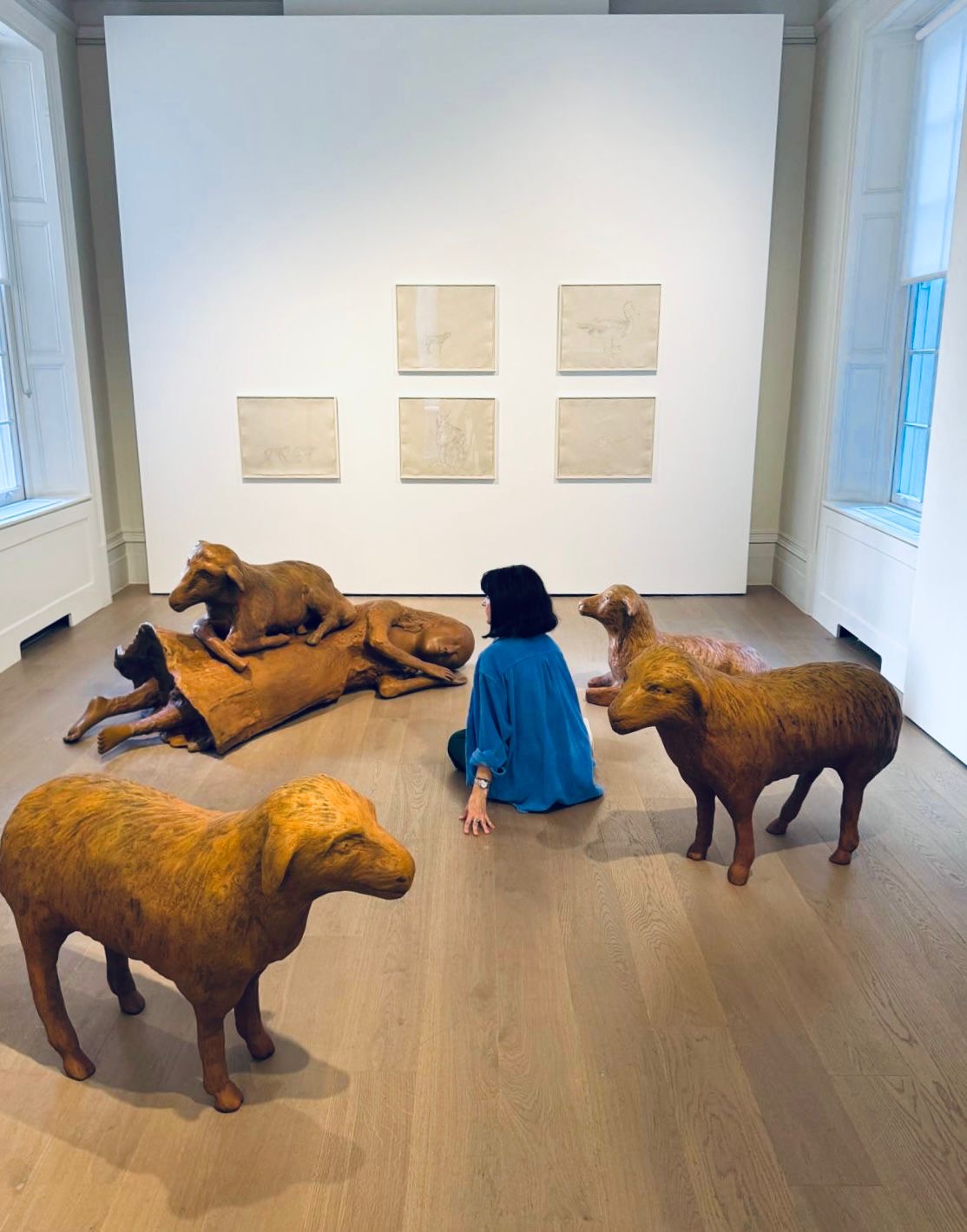
Upstairs, Flock (2025) — a group of three bronze lambs, two standing and one resting — is displayed beside Rest Upon (2009), a large bronze depicting a reclining female figure with a lamb resting on her side. In this tender and surprising encounter, both beings seem to offer each other comfort and protection.


Sheep have appeared in Smith’s work since the early 1990s — as has their predator, the wolf. Her engagement with these figures draws on Aesop’s fable about power and injustice, as well as the story of Saint Genevieve, the shepherdess and warrior whose devotion was said to reconcile even natural enemies.
Surrounding Flock and Rest Upon are delicate pencil and silver drawings depicting fragile creatures with spindly limbs and vacant, haunting eyes. Small bronze butterflies in varying sizes punctuate the space, heightening the sense of delicate life in motion.


In the next room stands Dark Water (2023), a patinated blue-bronze sculpture of a female figure hovering above the ground, surrounded by flowing, fluid forms. She seems immersed in the element of water — a poetic reminder of the deep interconnection between bodies and ecosystems. It made me think of Tropicalia, the exhibition I saw this summer at the Thyssen-Bornemisza Museum in Madrid, which explored similar themes of nature and human entanglement. You can read the review on the Tropicalia link above.


Finally, in a smaller adjacent room, an owl sculpture titled Horizon (2025) is displayed on a tall plinth. Around it, two-colour etchings, aquatints, and chromogenic prints immerse us further in Smith’s imagined world of species and natural elements.


This exhibition felt truly magical. Through folklore, biblical stories, and ancient mythologies, Kiki Smith transforms the gallery into a luminous, enchanted space — one that reminds us of our place within nature’s intricate web of forces. I thoroughly enjoyed this show and highly recommend it if you’re in London before it closes on 1 November.
Leave a Reply