
Marina Abramović
Royal Academy of Arts, London, UK
23 September 2023 – 1 January 2024
Marina Abramovic’s long-awaited 50-year retrospective is finally at the Royal Academy of Arts in London after Covid forced the institution to postpone what is the first retrospective given to a female artist.
Marina Abramović has become the grandmother of performance art. By pushing the limits of her body and mind to extremes, she has risked her health and even her life while extending her practice to embrace collective experiences of intimacy between artist and audience.
The show features a re-enactment of her most famous performances, achieving different levels of engagement from the audience. Upon entering the first dark room, you encounter ‘The Artist is Present,’ a restaging of one of her most famous performances through archive footage. Several dozen images of some of the 1,545 members of the public who came and sat opposite her in silence during the 75 days of her performance at New York’s MoMA in 2010 are presented. On one side, the attendees to the show; on the other, Marina Abramovic as she sat there with the camera pointing at her and capturing her reactions. It’s not usual for an artist to sit with her audience in such a way. The whole scene of Marina sitting in front of another person and dressing in such a long red dress reminds me of religious paintings from the Flemish Renaissance.


In the next room, you are introduced to her first performances as a young artist, a phase I didn’t know that well previously. Arguably, in her most famous performance, ‘Rhythm 0’ of 1974, she presented an array of objects to participants, inviting them to do as they would with her (Yoko Ono had set a precedent a decade before in her ‘Cut Piece’). A replica table is laid out at the Royal Academy: chains, scissors, whips, a rose, an apple, a loaded gun, which one man held to Abramović’s neck. Her courage was unmatched. You can see her with cuts on her body and totally impassive like a martyr in acceptance of her punishment.

The following room was a recreation of her ‘Balkan Baroque’ performance from 1997 at the Venice Biennale. Although the 1,500 bloody cattle bones she had washed then were faked up here. This and the following room where you can see Abramovich on top of a white stallion holding a giant white flag in ‘The hero’ (2001) offer a view of the artist’s background.
Coming from Serbia and growing up in a strict home environment, her parents had been partisan fighters during World War II, for which they were awarded the Order of the People’s Heroes. The artist lived with her maternal grandmother, who was deeply religious and spiritual, until she was 6 years old when she went to live with her parents after her brother was born. Her mother was a strict disciplinarian who also inflicted physical punishment, which sort of explains to me why she’s always so interested in subjecting the body to harshness. She was exposed to the arts from an early age through her mother’s job at the Cultural Ministry.


In the vast central gallery, you’ll encounter black and white period films where you can see the artist’s performances in the 70s with her partner at the time, the artist Ulay. They’ll be slapping each other’s faces, screaming at one another, and kissing each other. One of these works stands out, ‘Rest Energy’, where you see them performing a dangerous balancing act with an archer’s bow and arrow. If either of them gave an inch, one of them would have died.


From this point of the exhibition, you can see performances re-enacted by a new generation of artists trained by Abramovic at the Mariana Abramovic Institute. The first performers create ‘A pair of human gateposts’, two naked models making a barrier for visitors to pass through. The work re-creates ‘Imponderabilia,’ first staged in 1977 by the artist and Ulay. The performers may disturb some visitors, but I suspect the effectiveness of this isn’t the same as the original in the 70s.
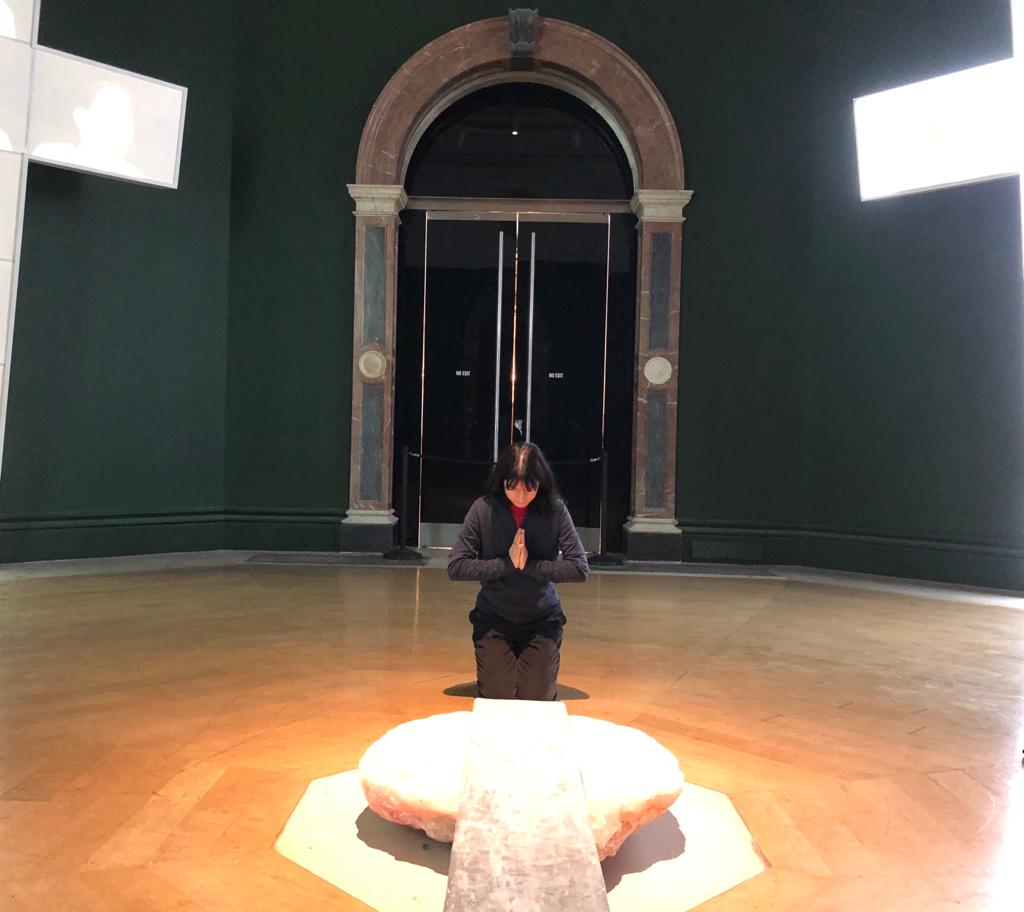
As you progress to the next part of the exhibition, the following rooms display her solo work with ‘Transitory Objects,’ where crystals and minerals are embedded and invite public participation. In this part of her trajectory, she had broken up with Ulay, choosing a performance walking along the Chinese Wall to say goodbye, and she shifted her interests to a healing approach. Energy therapy seems to become a big influence in her work from now on. And despite the criticism received for that, I did enjoy these works, more than others in fact, particularly entering the room with a batch full of chamomile; the smell of it and sounds of the waves were very soothing.


In one of the last rooms, ‘The Levitation of St. Therese’ (2009), in which the artist, dressed in black, hangs above a kitchen recreating a mystical experience in memory of the Spanish saint, was aesthetically interesting, and a clear evidence to me of the significant role spirituality has taken in her work. The influence of her grandmother seems to come afloat here.
Finally, the last room hosts the recreation of her work ‘The house with the Ocean View’ that saw the artist live in a house constructed for 12 days in the wake of the 9/11 terrorist attacks in New York. The performance invited audiences to witness and share in the simple act of living. This work didn’t resonate with me, simply because the works she does where there’s punishment or hardship inflicted to the body aren’t my favourites.
The influence of Abramović is undeniable; she has positioned herself as a pioneer in the use of the live body for art, leaving an impressive legacy. In her exploration of art as a means for emotional and spiritual transformation, she has constantly evolved, challenging her audience. Although the absence of herself in her performances in the present, given her age, may slightly diminish the impact of her works, the fascinating interest in discovering and observing her developments at each stage persists.


Leave a Reply